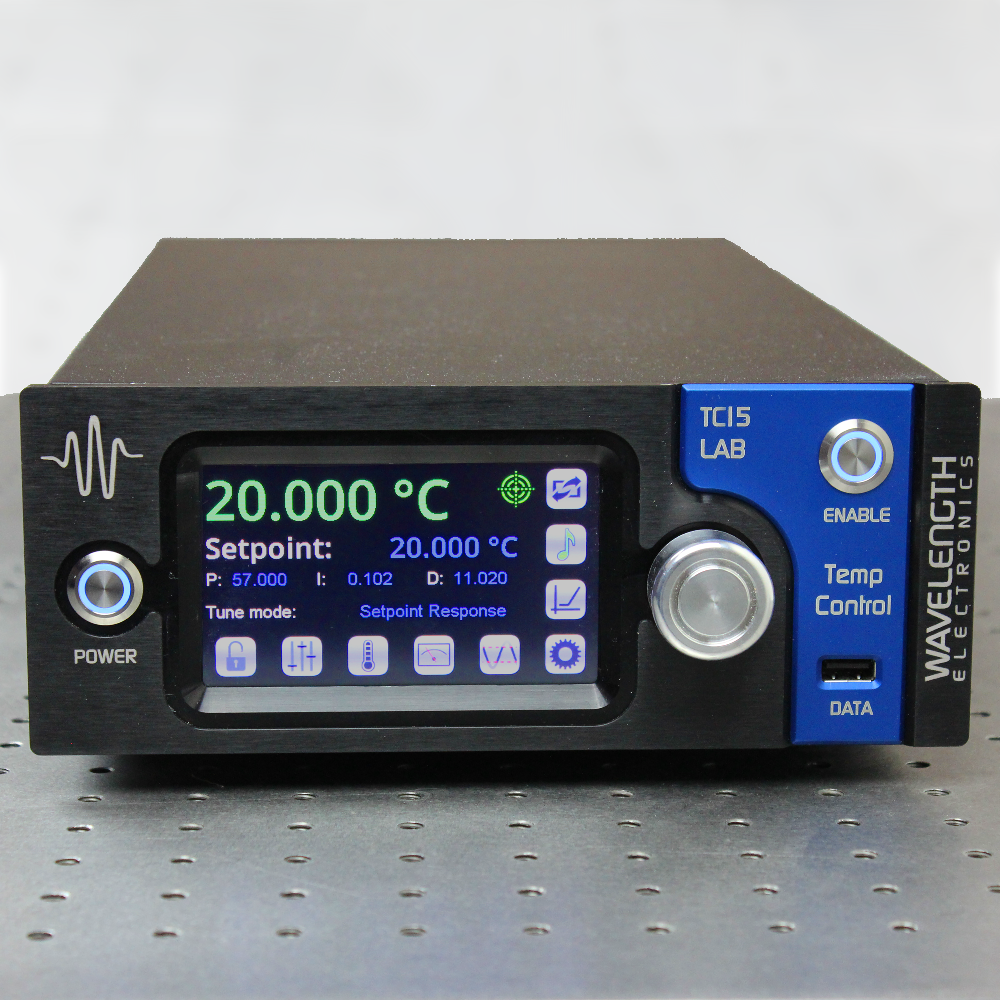
NEW: 15A / 20V PRECISION TEMPERATURE CONTROL INSTRUMENT

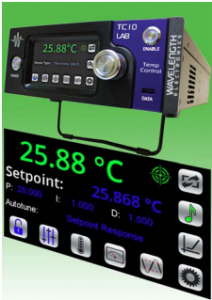
The TC15 LAB (15A, 20V) is an ultra-stable digital controller for thermoelectrics and resistive heaters where tight temperature stability is required. Designed using the latest technology, stability better than 0.0009°C can be achieved with thermistors. Precision temperature control is required in myriad applications. This high?powered controller makes development of complex systems or sophisticated experiments possible in biological sample control, laser diode or quantum cascade laser wavelength stabilization, spectroscopy, remote sensing, imaging, aerospace, communications, materials processing, pharmaceutical manufacturing control, environmental sensing, electro-optics, and more.
ULTRA-STABLE TEMPERATURE CONTROLLER

This best-in-class temperature controller offers:

  • Excellent stability (0.0009°) at 15 Amps up to 20 Volts to a thermoelectric or resistive heater
  • Intuitive touchscreen front panel – see setpoint, actual temperature, stability status all on one screen!
  • Extra safety — shut down your laser / QCL / active load if it goes outside user set temperature limits. Auxiliary sensor can monitor heat sink temperature.
  • Expanded Remote Command set — control and log data from a remote computer via USB (Test & Measurement Class) or Ethernet
  • Free LabVIEW VI executable for easy remote computer control
  • IntelliTune® optimizes PID control values to minimize time to temperature or reject external disturbances
  • IntelliTune®keeps adapting the PID control values as setpoint, tuning mode or sensor bias current is changed
  • Compatible with all sensors — thermistor, RTD, LM335, AD590.
SAFETY IS BUILT IN

Over and under temperature limits as well as positive and negative current limits can be set. If the sensor signal is lost or a short is detected at the thermoelectric, output current is disabled. If temperature limits are exceeded, a signal to the active laser load can be sent to disable its current. For example, connect the LD Shutdown BNC output to the Active Lock input on Wavelength’s QCL LAB driver and the QCL current will shut down if temperature limits are exceeded. An Auxiliary Sensor can be used to monitor the temperature of the system heatsink.

INTELLITUNE

Instead of long, manual calculations to derive the optimal Proportional, Integral, and Derivative [PID] control terms for a load, press the IntelliTune icon and the instrument will automatically cycle through a characterization test to tune the control terms for best performance. Two methods of IntelliTune are available. Setpoint Response optimization will minimize the time to temperature for the load. Disturbance Rejection optimization is best when there will be significant changes to the ambient temperature or operating condition. This could be for a pulsing laser diode where the active heat load changes or a sample that is to be tested in changing ambient temperatures. For detailed exploration of IntelliTune, download Application Note AN-TC13: IntelliTune vs. Conventional Autotune.

Take your research to the next level.

For more information, download the datasheet.

QuickStart video simulates controlling temperature for a spectroscopy application using a laser with an embedded 3A thermoelectric and a 10kΩ thermistor. It takes you through all the steps necessary to control the laser temperature quickly and easily.

Safely produce consistent, optimum power from your laser diode

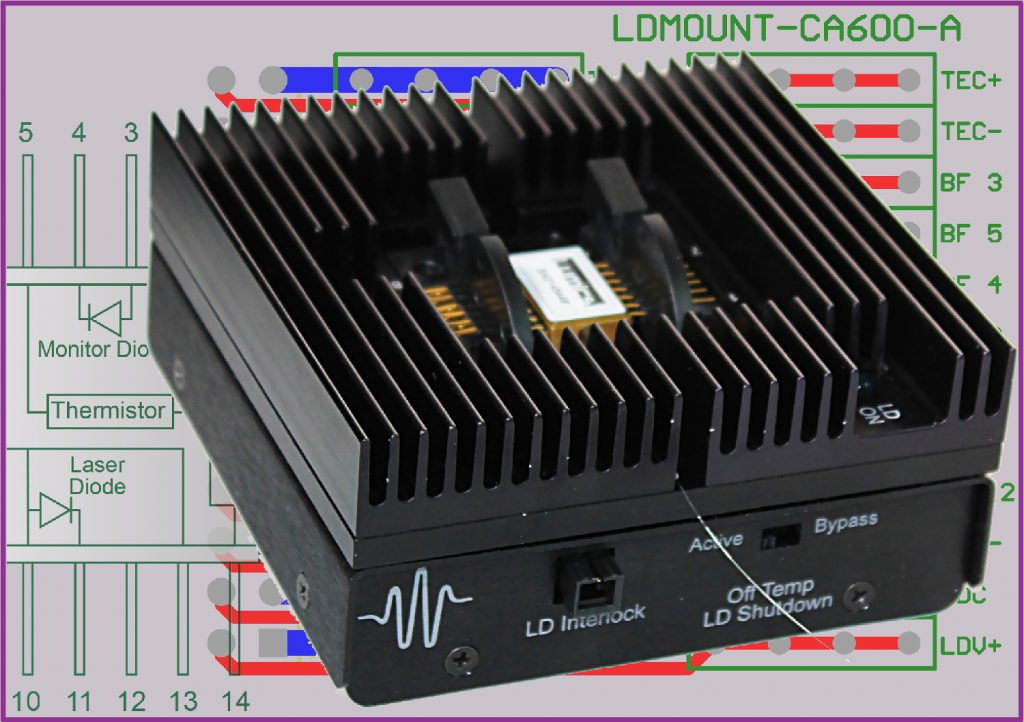
The LDMOUNT is ideal for pump and communication diode lasers. The LDMOUNT from Wavelength Electronics is designed for optoelectronic modules in a 14-pin butterfly package that require up to 5A. With integrated heatsinking, built-in safety features, and easy connection to eight different high performance Wavelength controllers, the LDMOUNT can be used in a variety of applications, mounted on an optics table or to a chassis.

FEATURES & BENEFITS
  • Capable of running lasers up to 5 A
  • Compatible with 14-pin butterfly laser diode packages
  • Type 1 & Type 2 butterfly packages are supported with pre-soldered connection card
  • Other laser types supported with customer soldered Custom Butterfly Card
  • Zero insertion force (ZIF) socket holds laser diode
  • Laser interlock safety circuit
  • Mounts to an optics table with standard 1/4-20” screw
  • Compatible with 8 Wavelength temperature controllers and laser drivers
VERSATILITY

Designed for 14-pin butterfly laser diodes with internal thermistors and Thermo Electric Coolers (TEC), the LDMOUNT is a laser diode mount with integrated heat sinking, and simple connections between the drivers and the diode laser. A zero insertion force (ZIF) socket holds the laser. Two 9-pin DSUB connectors enable TEC and laser driver control. Two basic butterfly laser diode types are supported. For any other pinout, the LDMOUNT-CU Card is available for hand wiring.

The LDMOUNT is designed for use with laser diodes that have the laser diode anode (LDA) grounded. As such, the laser diode cathode (LDC) is at a negative potential. The LDMOUNT is designed to operate at temperatures below 50°C. The user is able to change between the types easily by using the provided pre-configured connection card.

SAFETY

The LDMOUNT has several built-in safety features. These include a reverse bias protection diode across the laser diode, an interlock circuit for the laser diode current, and a TEC Active/Bypass switch to require active temperature control before laser current can be enabled.

Wavelength Electronics is a Proud Member of MPIA – Promoting Photonics in Montana

The Montana Photonics Industry Alliance serves as a hub for Montana’s optics and photonics companies, entrepreneurs, laboratories, and universities to commercialize, grow and sustain globally leading organizations that create high quality jobs and economic opportunity in Montana.

MPIA
  • Supports initiatives designed to start, grow and attract new optics and photonics companies to Montana
  • Promotes optics and photonics job opportunities in Montana to attract top quality professionals to the state
  • Supports efforts to build the state’s optics and photonics technology research base
  • Exchanges information about common issues and opportunities
  • Pools resources to support joint training, research and development and business development projects that advance the competitiveness of Montana optics and photonics companies
  • Educates the public and students about optics and photonics career opportunities
  • Serves as an interface between Montana optics and photonics companies and state educational institutions
  • Serves as the interface between Montana optics and photonics companies and state government
The video highlights reasons to locate a Photonics business in Bozeman, MT. It was shown at Laser World of Photonics in June 2017.

VIDEO: TC LAB Series Temperature Control Instrument Quick Start

This video will help you quickly operate the TC LAB instrument. In this video, we will simulate controlling laser temperature for a spectroscopy application. Embedded with the laser is a thermoelectric with a maximum current of 3A and a 10kΩ thermistor.

Photonics West 2017 – What’s New

Come visit us at booth #908 at Photonics West January 31 to Feb 2 in San Francisco. We‘ll have several instruments operating so you can experience the touchscreen interface and see how simple operation can be!
 
QCL LAB low noise Quantum Cascade Laser drivers (up to 2A 0.4nA / √Hz noise floor) now are TMC class and we’ve released a Labview Virtual Instrument and full Command set. See how to get your free firmware upgrade.
 TC LAB Temperature Control instruments (5A & 10A; 15V) with IntelliTune: Intelligent Autotune. With one quick scan, your thermoelectric stays optimally controlled even if you change setpoint or tuning mode.
QCL + PTC OEM current and temperature control for a Quantum Cascade Laser.
 
In one compact package, QCL10PTC10, you get safe, low noise control of a 1A Quantum Cascade Laser (0.5µA RMS to 100kHz), and up to 10A of precision temperature control with stability better than 0.0012°C.
 
Our team of engineers would love the opportunity to talk with you about your application. Feel free to make an appointment ahead of time if you’d like to look more in-depth at your project.

Now Available — IntelliTune™: Intelligent Autotune Integrated with the TC LAB Series Instruments

Wavelength’s proprietary IntelliTune™ algorithm characterizes the TEC / Sensor system’s response to the TC LAB temperature controller and then automatically adjusts the PID control values as setpoint, tuning mode, or bias current are changed.

  • Run IntelliTune™ easily just off ambient and watch the TC LAB instrument adapt the PID settings to a much higher or lower setpoint.
  • After a single characterization scan, explore either optimized Setpoint Response or Disturbance Rejection performance to see what tuning mode works best with your load.
  • Try the system with or without the D term to see if noise reduces stability around the setpoint.

With IntelliTune’s ability to recalculate control values, the temperature controller becomes a tool for speeding up experimental studies. Questions like “What are the best PID control coefficients to use?” can now become “Which mode achieves best stability fastest?” or “Should I use the D term or leave it out?”. These are quickly and easily answered.

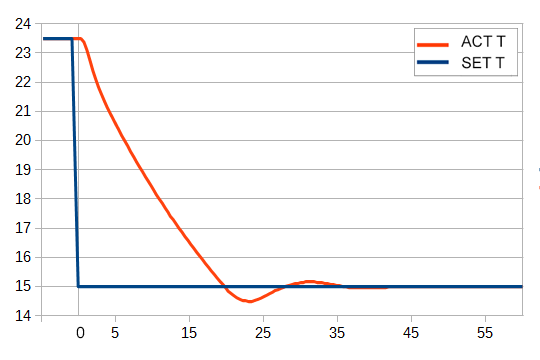
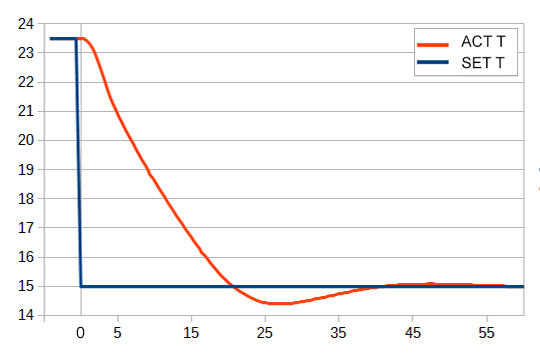
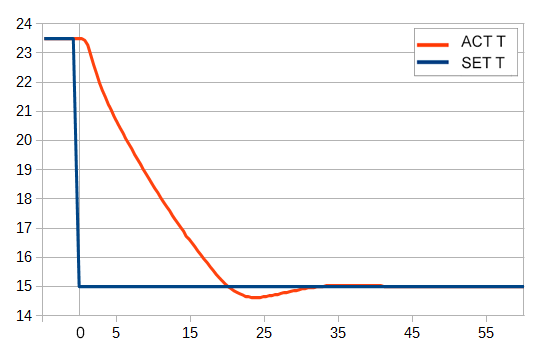
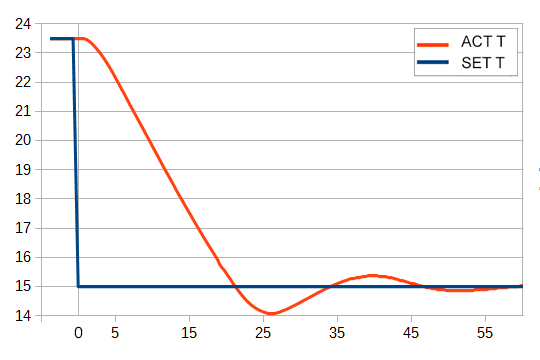
We studied the TCLAB with a 3A thermoelectric load to explore what IntelliTune™ makes possible. For example, the following graphs demonstrate the step response to a change in setpoint. They show time to temperature for two modes – Setpoint Response or Disturbance Rejection – with or without the Derivative control term. All PID control values were automatically generated by IntelliTune after one characterization scan. The complete report can be found HERE. We invite you to try out IntelliTune on your load(s) and see what a time saver it can be.

Tuned, 39.9 seconds to stable temperature First crossing of setpoint: 19.9 seconds P = 14.081; I = 1.408; D = 1.594 Setpoint Response
Tuned, 52.2 seconds to stable temperature First crossing of setpoint: 20.7 seconds P = 14.081; I = 0.352; D = OFF Disturbance Rejection
Tuned, 32.0 seconds to stable temperature First crossing of setpoint: 20.9 seconds P = 22.295; I = 0.929; D = 2.120 Disturbance Rejection
Tuned; 57.1 seconds to stable temperature First crossing of setpoint: 21.3 seconds P=8.214; I= 0.685; D=OFF Setpoint Response
Tuned, 39.9 seconds to stable temperature First crossing of setpoint: 19.9 seconds P = 14.081; I = 1.408; D = 1.594 Setpoint Response
Tuned, 52.2 seconds to stable temperature First crossing of setpoint: 20.7 seconds P = 14.081; I = 0.352; D = OFF Disturbance Rejection
Tuned, 32.0 seconds to stable temperature First crossing of setpoint: 20.9 seconds P = 22.295; I = 0.929; D = 2.120 Disturbance Rejection
Tuned; 57.1 seconds to stable temperature First crossing of setpoint: 21.3 seconds P=8.214; I= 0.685; D=OFF Setpoint Response

NEW — PRECISION TEMPERATURE CONTROL INSTRUMENTS

June 27, 2016

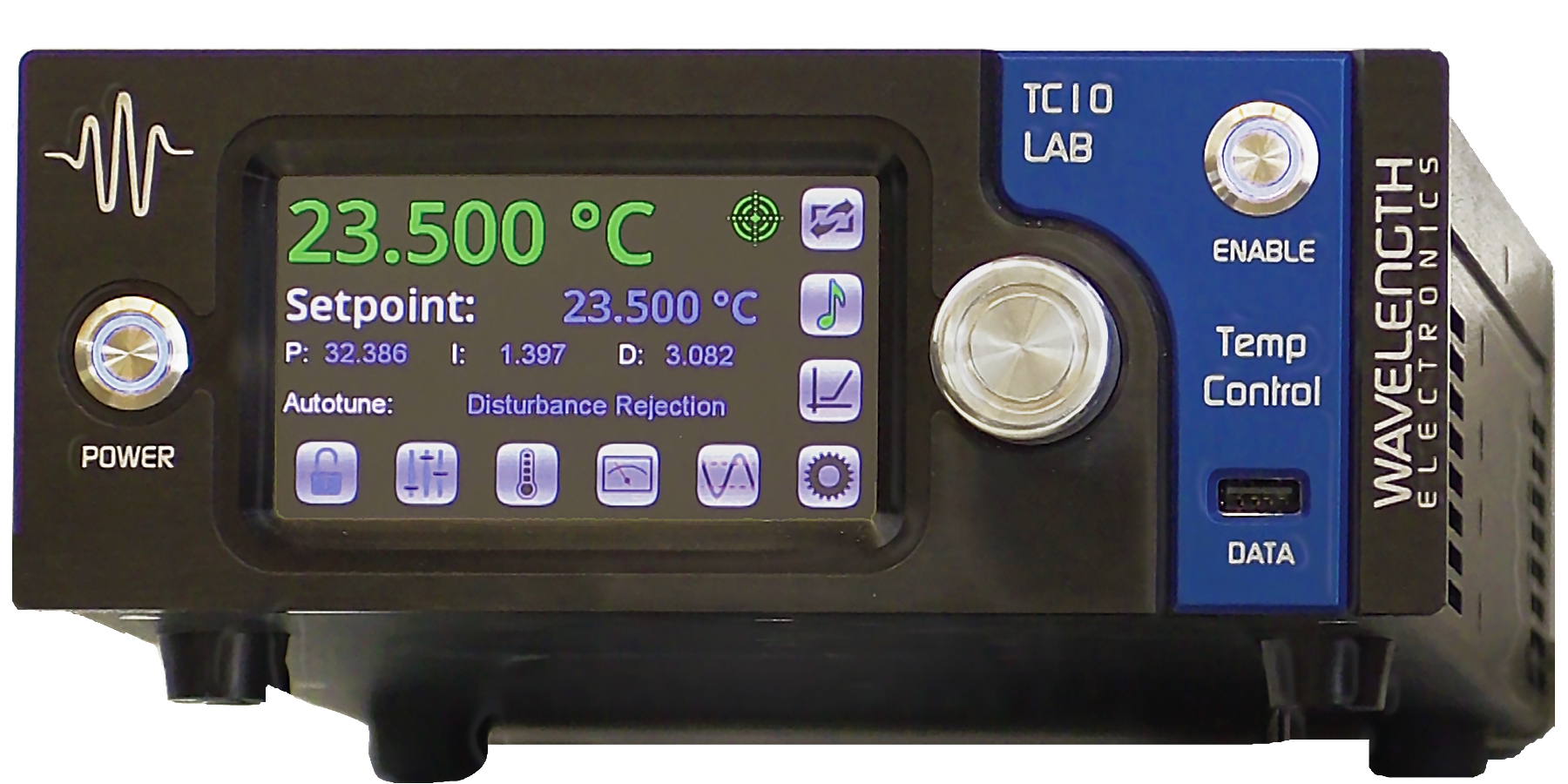
The TC10 (10A, 15V) and TC5 (5A, 15V) are ultra-stable digital controllers for thermoelectrics and resistive heaters where tight temperature stability is required.
Designed using the latest technology, stabilities better than 0.0009°C can be achieved with thermistors. High stability enables researchers to precisely monitor trace gases in fracking, bio-samples in life-sciences, and semiconductor performance. Tight control enables applications in electro-optics, imaging, spectroscopy, remote sensing, military, aerospace, communications, material procesing, and environmental or manufacturing control.

ULTRA-STABLE TEMPERATURE CONTROLLER
These best-in-class temperature controllers offer:

  • Excellent stability (0.0009°C) at 5 & 10 Amps up to 15 Volts
  • Intuitive touchscreen front panel – see setpoint, actual temperature, stability status all on one screen!
  • Extra safety – shut down your laser / QCL / active load if it goes outside user set temperature limits. Auxiliary sensor can monitor heat sink temperature.
  • Expanded Remote Command set – control and log data from a remote computer via USB (Test & Measurement class) or Ethernet
  • Autotune optimizes PID control values to minimize time to temperature or reject external disturbances
  • Active Autotune keeps adapting the PID control values as setpoint is changed
  • Interface with the NEW IR Sensor to monitor temperature of liquids and solids REMOTELY, avoiding contact or contamination with the sample.
  • Compatible with all sensors – thermistor, RTD, LM335, AD590.

SAFETY IS BUILT IN
Over and under temperature limits as well as positive and negative current limits can be set. If the sensor signal is lost or a short is detected at the thermoelectric, output current is disabled. If temperature limits are exceeded, a signal to the active laser load can be sent to disable its current. For example, connect the LD Shutdown BNC output to the Active Lock input on Wavelength’s QCL LAB driver and the QCL current will shut down if temperature limits are exceeded. An Auxiliary Sensor can be used to monitor the temperature of the system heatsink.

ACTIVE AUTOTUNE
Instead of long, manual calculations to derive the optimal Proportional, Integral, and Derivative [PID] control terms for a load, press the Autotune icon and the instrument will automatically cycle through a characterization test to tune the control terms for best performance. Two methods of Autotune are available. Setpoint Response optimization will minimize the time to temperature for the load. Disturbance Rejection optimization is best when there will be significant changes to the ambient temperature or operating condition. This could be for a pulsing laser diode where the active heat load changes or a sample that is to be tested in changing ambient temperatures.

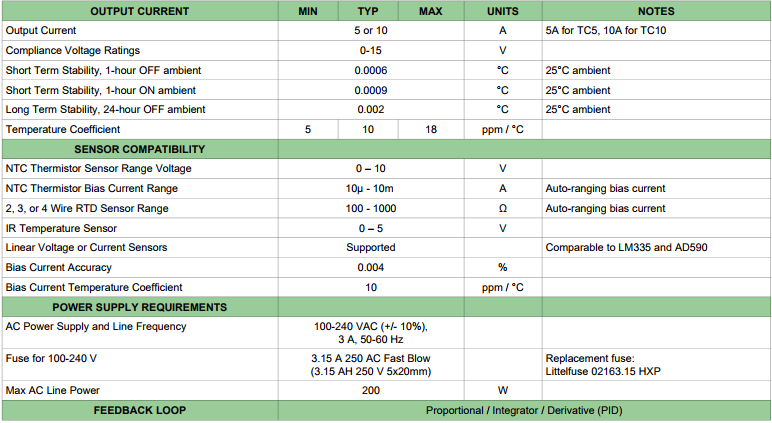
SPECIFICATIONS


Introduction / Welcome

WELCOME TO LASER / TEC CONNECT

For twenty years, Wavelength has delivered OEM laser drivers and temperature controllers that help you get your product to market quickly, at low cost, and with outstanding performance. Basically, our goal is to help you succeed. With that in mind, we’re pleased to offer this newsletter to share our experience in laser and temperature control with this newsletter. We hope you find our newsletter helpful and feel free to contact us if you would like to see a particular topic covered.

SUBSCRIBE TO OUR NEWSLETTER FOR TIPS, TECHNIQUES & PRODUCT UPDATES.

WHAT IS A LASER DIODE DRIVER?

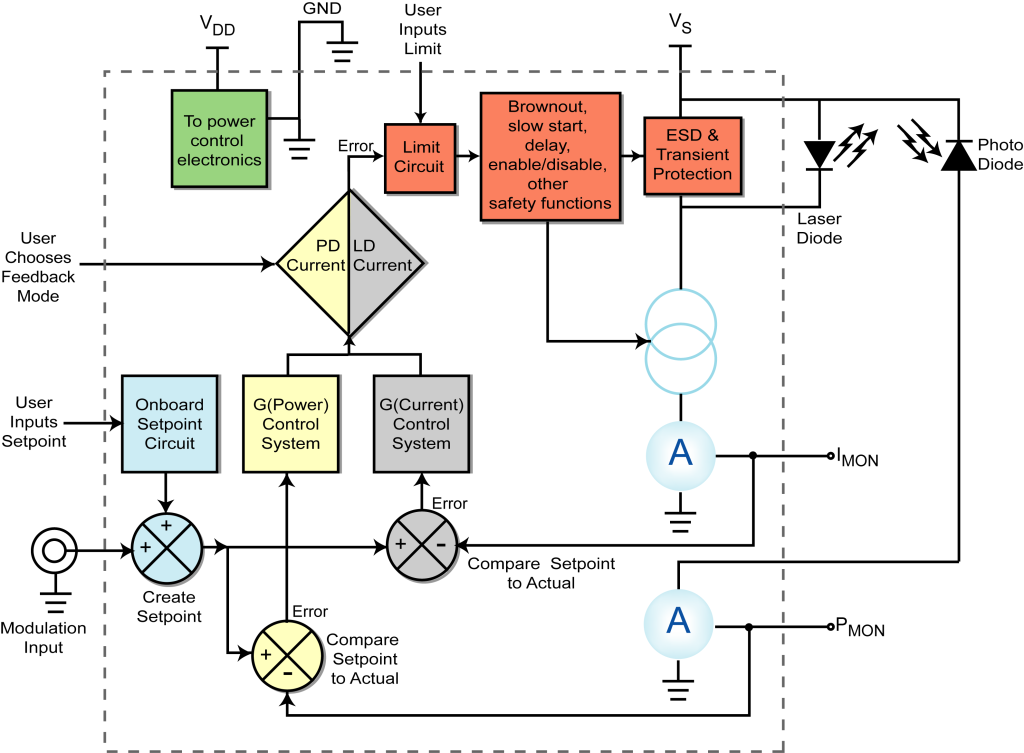
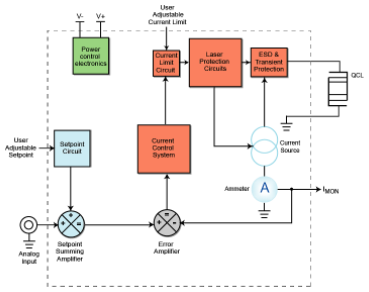
A laser diode driver has to be more than just a power supply in order to achieve the best possible performance from expensive and delicate laser diodes. A precision current source is necessary, and in order to protect the laser diode and make the system more robust, particular safety and operational features are critical. This webpage explains how the laser diode drivers work, and what to look for in a high-quality driver.

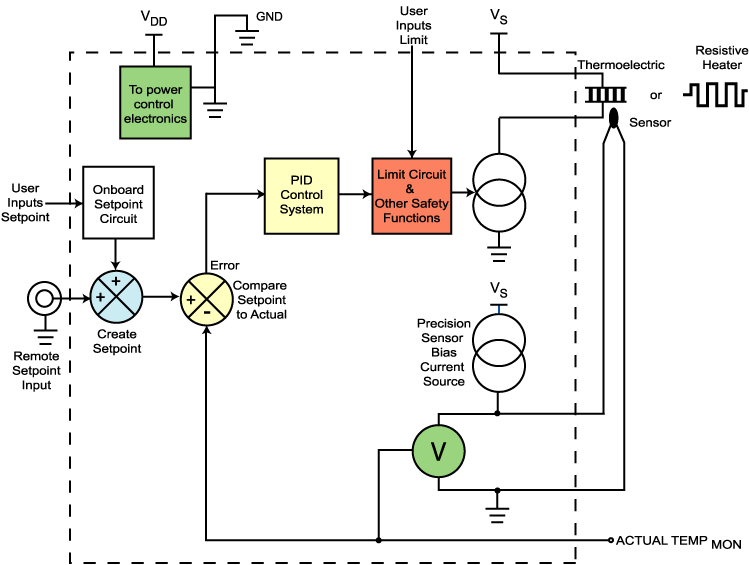
Temperature Controller Schematic

WHAT IS A TEMPERATURE CONTROLLER?

A properly designed temperature controller will maintain the load temperature at a very stable and repeatable temperature over an extended period of time, and through a range of operating conditions. A well designed controller includes safety features to protect the load, interfaces with a variety of sensors and loads, and is versatile enough to fit nearly any application space. This webpage describes how high-stability temperature controllers work.

QUANTUM CASCADE LASER DRIVERS, EXPLAINED

A laser diode driver has to be more than just a power supply in order to achieve the best possible performance from expensive and delicate laser diodes. A precision current source is necessary, and in order to protect the laser diode and make the system more robust, particular safety and operational features are critical. This webpage explains how the laser diode drivers work, and what to look for in a high-quality driver.

We invite you to contribute topic suggestions, questions, and general feedback.
Wavelength will incorporate as much reader input as possible.
Click to Submit

SUBSCRIBE TO OUR NEWSLETTER FOR TIPS, TECHNIQUES & PRODUCT UPDATES.