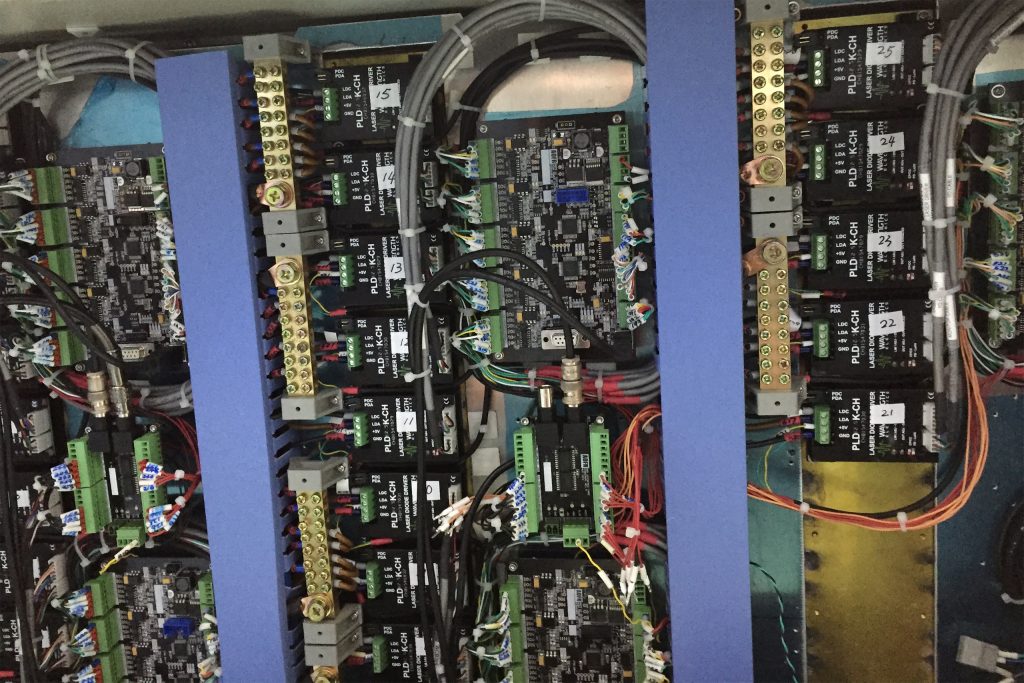
Fusion splicing creates a permanent connection by precisely cleaving and aligning the fiber cores, then using an electric arc to melt and fuse the glass. Core misalignment, fiber geometry, and imperfections in the cleave can all contribute to optical loss across the finished splice.
The quality of the splice can then be evaluated by examining how light propagates through the joined fibers. In one splice-loss estimation technique, light is directed through the cladding on one side of the splice, and the light leaking from the cladding on the opposite side is measured. This provides an estimate of splice quality and helps identify connections that may require additional attention.
In high-volume telecommunications manufacturing, the test system itself must deliver consistent and repeatable performance. Precision laser diode current control helps provide stable optical sources for measurement, allowing manufacturers to focus on the characteristics of the fiber and splice rather than variations introduced by the test equipment.
The PLD12.5K-CH is designed to provide stable laser diode current in a chassis-mount format, making it well suited for multi-channel and production test systems. In this application, a bank of twenty-five drivers provides a scalable laser-control platform for simultaneous or high-throughput fiber splice testing.
Learn more about the PLD12.5K-CH 12.5 A Laser Diode Driver.