




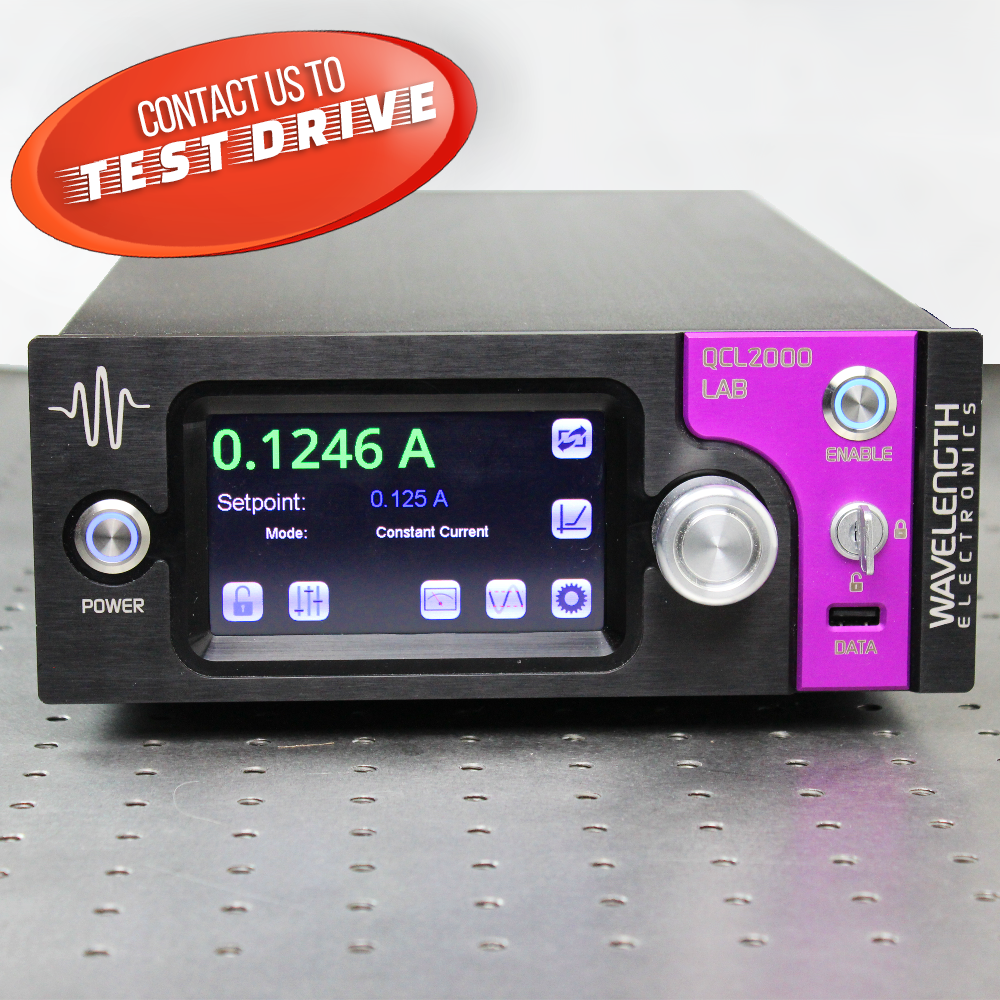
 LOWEST NOISE QCL INSTRUMENT AVAILABLE
These low noise QCL driver instruments have the lowest current noise density of any commercially available. They enable lower detection thresholds in gas, liquid, and material sensing systems. Powering a QCL with Wavelength’s patented1 driver gives you narrower linewidths, stable center wavelength, and repeatable scans.
This is the right instrument for lasers that require a high-precision and ultra-low noise current source to measure concentrations lower than ever before. The 2 A QCL driver exhibits noise performance of 1.3 μA RMS to 100 kHz, and an average current noise density of 4 nA / √Hz. To help you get the best performance from your QCL driver, Wavelength provides on-line Application and Technical notes:
AN-LD08: Manage Grounding to Minimize Noise with the QCL Drivers
AN-LD09: Troubleshooting Low Noise Systems
TN-LD02: How is Current Noise Measured at Wavelength Electronics
We are sure that once you experience the precision, stability and ease-of-use of our touchscreen instruments, you’ll be convinced that they are ideal for your high performance application. We are offering a test drive any instrument for 30 days for free. Activate the test drive.
CHOOSE THE RIGHT OUTPUT CURRENT RANGE TO MINIMIZE NOISE
The QCL Driver family is available in four different instrument models so that you can choose the ideal one for your application:- 500 mA with the QCL500 LAB
- 1 A with the QCL1000 LAB
- 1.5 A with the QCL1500 LAB
- 2 A with the QCL2000 LAB
ULTRA-NARROW QCL LINEWIDTH
In order to maintain a characteristically tight center linewidth and minimize jitter, quantum cascade lasers must be powered by drivers with exceptionally low current noise density. Our customers have reported achieving narrower linewidths with our QCL drivers than any other they’ve used.HIGHEST MODULATION BANDWIDTH
The high modulation bandwidth and fast rise-time maintains modulation waveform integrity so you can shape the laser output profile exactly as your application requires.INTUITIVE USER INTERFACE AND SUPERIOR SOFTWARE CONTROL
With Wavelength’s plug and play instrument, controls are set quickly using either the instrument touchscreen or a remote computer, and results are easy to monitor. This allows taking your revolutionary QCL application from the test bench to market quickly and efficiently. A LabVIEW Virtual Instrument application is available for remote operation. Complete installation and operation instructions can be found in the Virtual Instrument Operating Guide. Remote operation is also possible using the USB and Ethernet Test and Measurement Class Command Set. Complete installation and operation instructions can be found in the LAB Series Command Set document. If you are using the QCL LAB with firmware version 0.79 or earlier, it is remotely controlled using Wavelength’s QuickConnect Application (QCA):- QCL LAB Firmware Version 0.79 Instrument Datasheet
- QCL LAB QuickConnect Application Download, 32-bit
- QCL LAB QuickConnect Application Download, 64-bit
PROTECT YOUR QCL INVESTMENT
All the essential control and monitor functions expected in a Wavelength product are incorporated into this QCL driver, along with protection circuitry to safeguard the QCL from minor power source faults, over-temperature conditions, and electrical faults. The soft-clamping current limit can be set without enabling the driver output, and uses a brick-wall never-exceed limit circuit to protect the QCL from potentially damaging overcurrent situations. Additionally, the QCL instrument comes standard with many other safety features:- Power supply over current protection
- Brown-out and overvoltage protection
- Driver over-temperature protection circuit
- Relay shorts output when current is disabled
- AC input and patented power supply filtering
- Key switch, active, and passive interlocks
- Password protection available to lock out a selectable control set.
- 2 second turn-on delay
- 1.5 msec current ramp
USEFUL ACCESSORIES
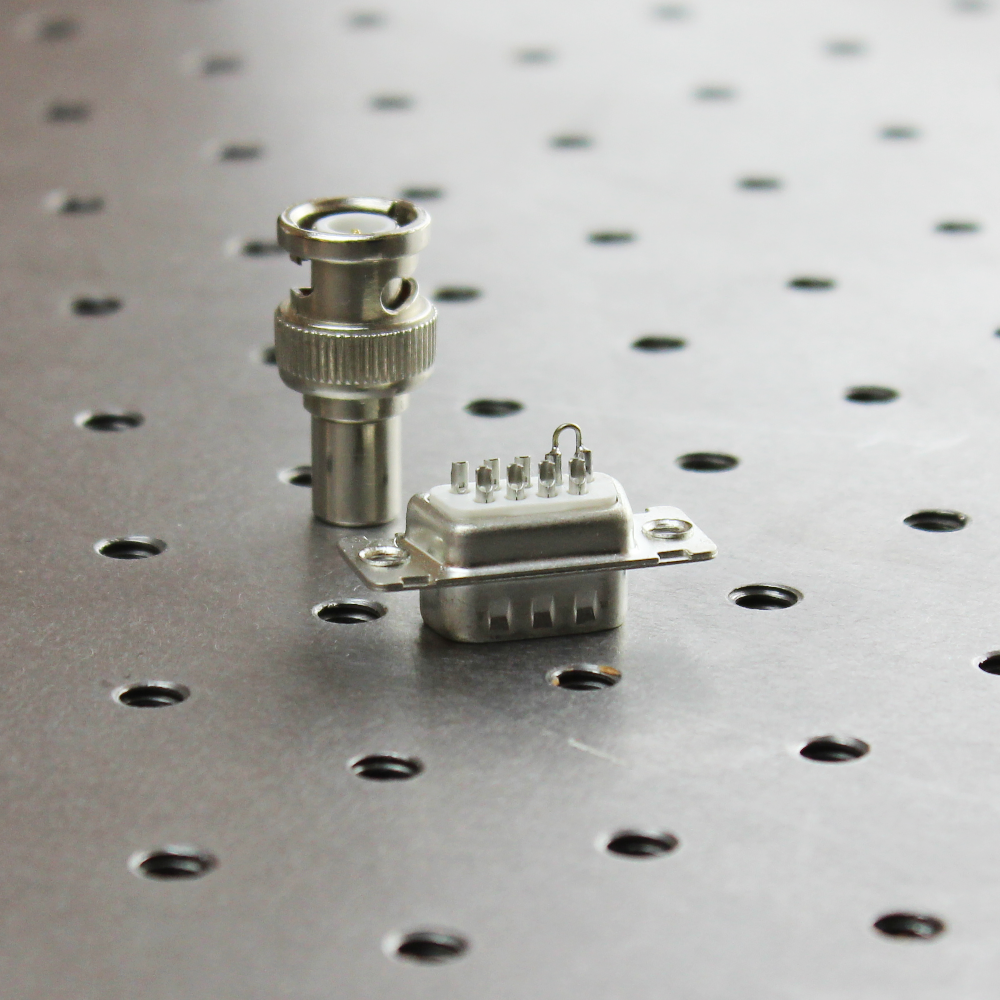
An Interlock Kit, which includes a BNC terminator and modified D-SUB connector to override interlocks, is included with the instrument. Single and dual rack mount kits are available. Windows-based software also comes with the instrument. A rack mount temperature control instrument, the TC LAB Series, is available: TC10 LAB 10A Controller TC15 LAB 15A ControllerOEM VERSION AVAILABLE
Once you have finalized your work, the QCL circuitry is available in compact OEM versions:APPLICATIONS
Due to their unique construction, QCLs operate with high power in the near-IR through terahertz ranges. These wavelengths are particularly suited to detection of molecules significant to humans. Applications for the lower noise QCL driver include: remote detection of explosive materials, medical diagnosis using the breath, non-invasive glucose testing, emissions monitoring of the atmosphere or marine environments, and pharmaceutical process quality control. Additional applications include anesthesia and hospital air quality monitoring, leak detection, remote imaging, and cavity ring-down spectroscopy. 1Covered by U.S. Patents 6,696,887; 6,867,644 and 7,176,755. Licensed from Battelle Memorial Institute. Free, effective, and responsive technical support is available to simplify integration of Wavelength products into your OEM design. Standard product can be easily modified to meet your application requirements.Dimensions: 3.5 x 8.8 x 17.7 inches (89 x 221 x 450 mm)
Supply Range: 115 / 230 ±15% VAC, Switch selectable: 110-120 V and 220-240 V
Output Current: 2 A
Compliance Voltage: up to 20 V (The unit will only deliver the voltage that the load requires, up to the compliance voltage limit.)
Long-term Current Stability at ambient 25°C: typically 10 ppm
Temperature Coefficient: typically 10 ppm
RMS noise 1 Hz to 100 kHz: typically 1.3 µA
Competitor Noise Comparison
Average Current Noise Density: 4 nA / √Hz
Noise Characterization Scan: Spectral Noise Scans are available from 1 Hz – 100 kHz. Request at time of purchase.
Bandwidth: 2 – 3 MHz (CC). Bandwidth will depend on QCL impedance and wire lengths.
Rise / Fall times: 250 nsec (to full scale) / 200 nsec
QCL Instrument Specification Comparison Chart
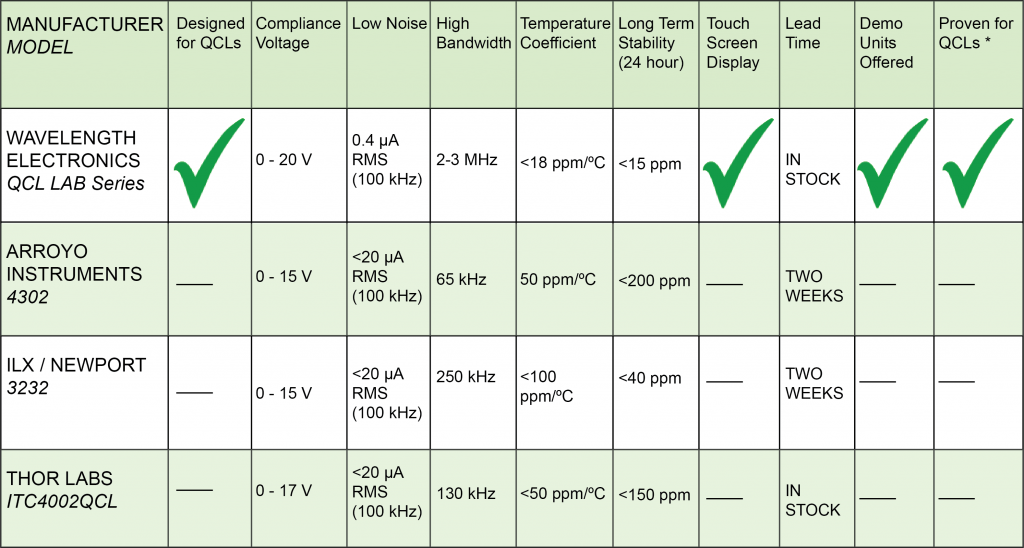
* Citations for the QCL Series:
- Patents 6,696,887; 6,867,644 and 7,176,755. Licensed from Battelle Memorial Institute.
- Design and performance of a dual-laser instrument for multiple isotopologues of carbon dioxide and water, McManus (Aerodyne), 2015
- Dual-modulation Faraday Rotation Spectrometer for Real-time Detection of Nitric Oxide (NO) Isotopes in Human Breath, and Nitrate/Nitrite in Urine/Blood, Zhang (Princeton University), 2015
- Mobile mapping and Eddy Covariance flux measurements of ammonia (NH3) emissions with a portable Quantum Cascade Laser-based open-path sensor, Tao (MIRTHE), 2015
- Open-path, quantum cascade-laser-based sensor for high-resolution atmospheric ammonia measurements, Miller (Princeton University), 2014
- Shot-noise Limited Faraday Rotation Spectroscopy for Detection of Nitric Oxide Isotopes in Breath, Urine, and Blood, Wang (Princeton University), 2015
- Patent 8,970,842 B2 — MULTI-HARMONIC INLINE REFERENCE CELL FOR OPTICAL TRACE GAS SENSING, Kang Sun (Princeton University), 2015
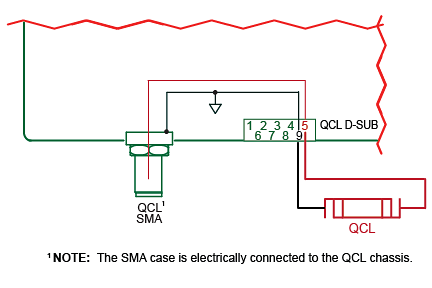
Quick Start Wiring Diagram
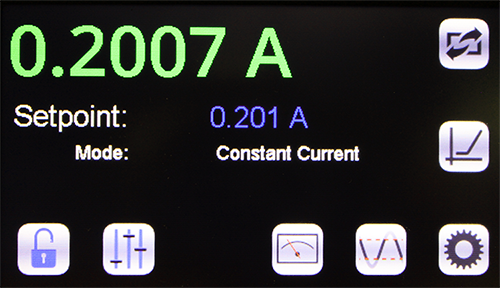
Instrument Control Screen
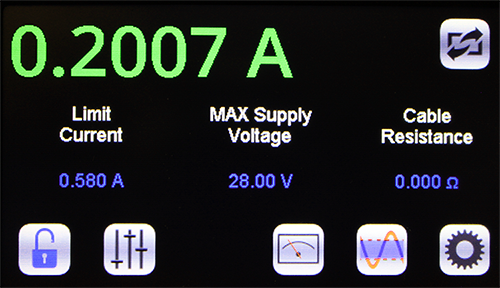
Instrument Limit Screen
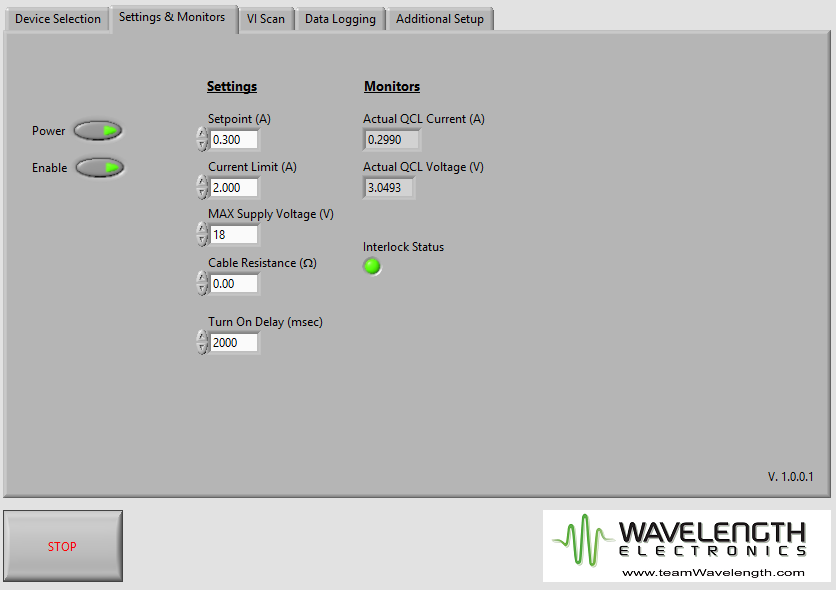
LabVIEW Virtual Instrument Settings & Monitor Screen
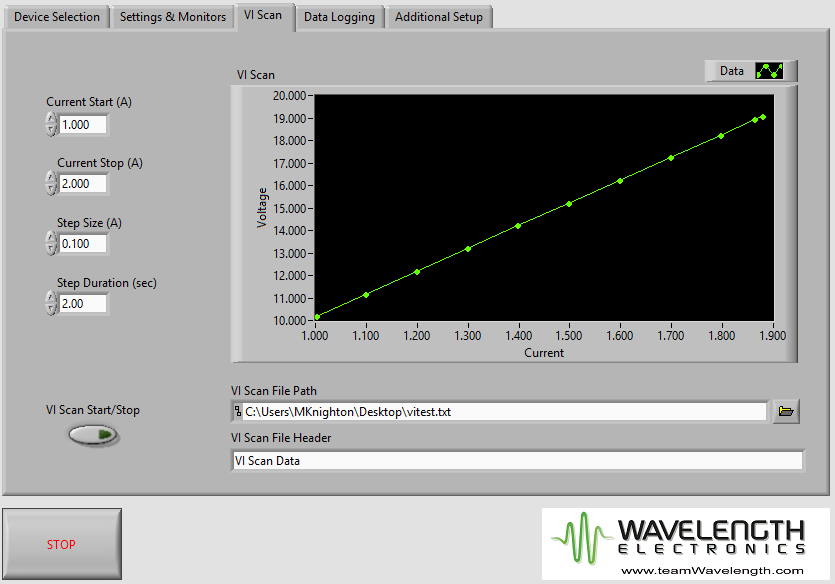
LabVIEW Virtual Instrument VI Scan Screen – Scan of Resistive Test Load
| SKU | DESCRIPTION | PRICE | IMAGE |
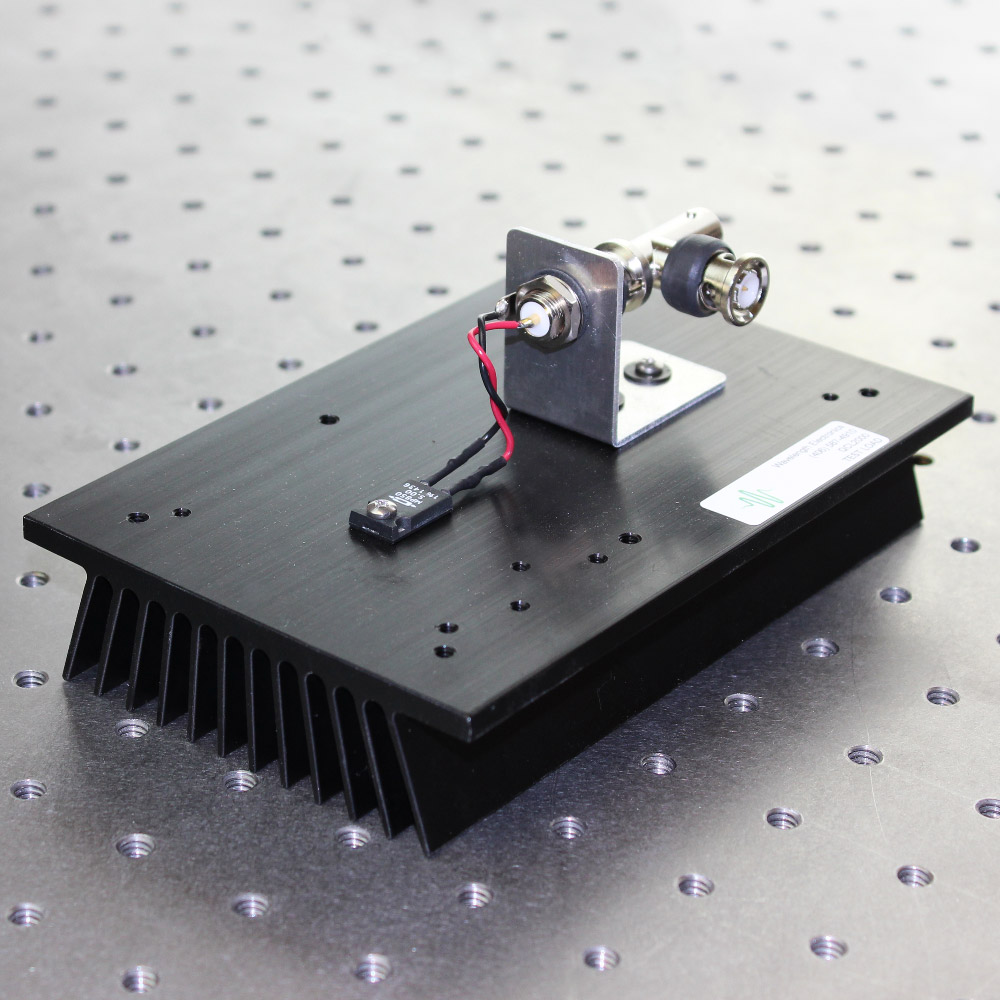
| QCLTL-2000 | QCL Test Load for QCL2000 |
$100.00 You save (%) |
 |
| INTLK REPL KIT | QCL Lab Series Interlock Replacement Kit |
$35.00 You save (%) |
 |
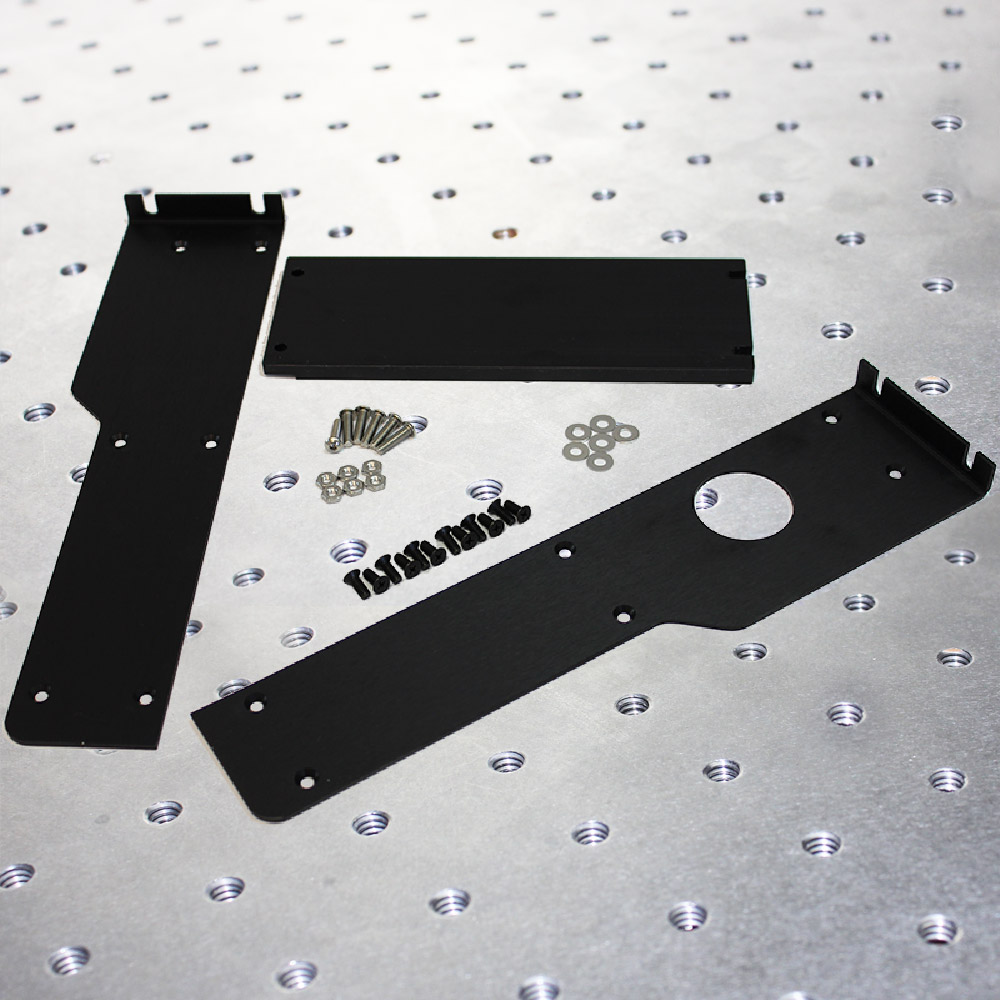
| RCKMT-LABSNGL | Laboratory Series Single Unit Instrument Rack Mount Kit |
$220.00 You save (%) |
 |
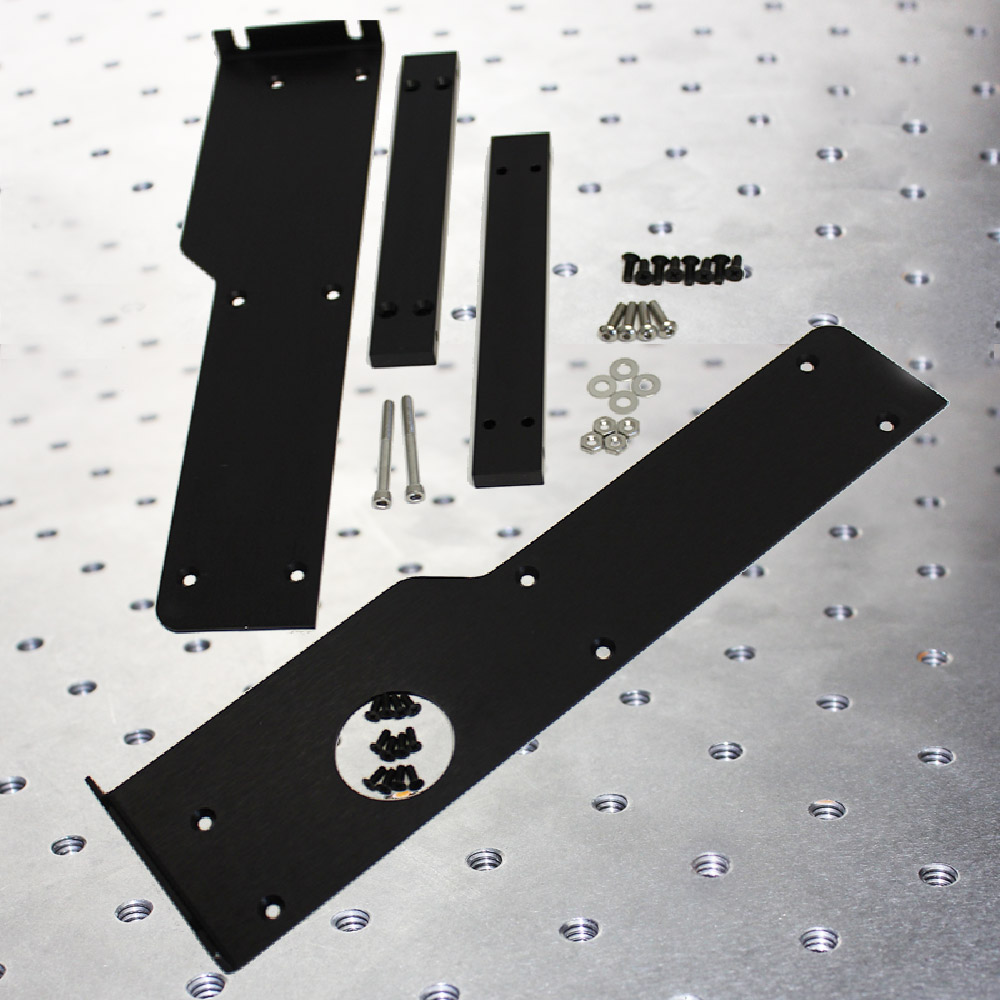
| RCKMT-LABDUAL | Laboratory Series Dual Unit Instrument Rack Mount Kit |
$275.00 You save (%) |
 |
| 55-110014 | SMA to BNC Cable | $45.00 | 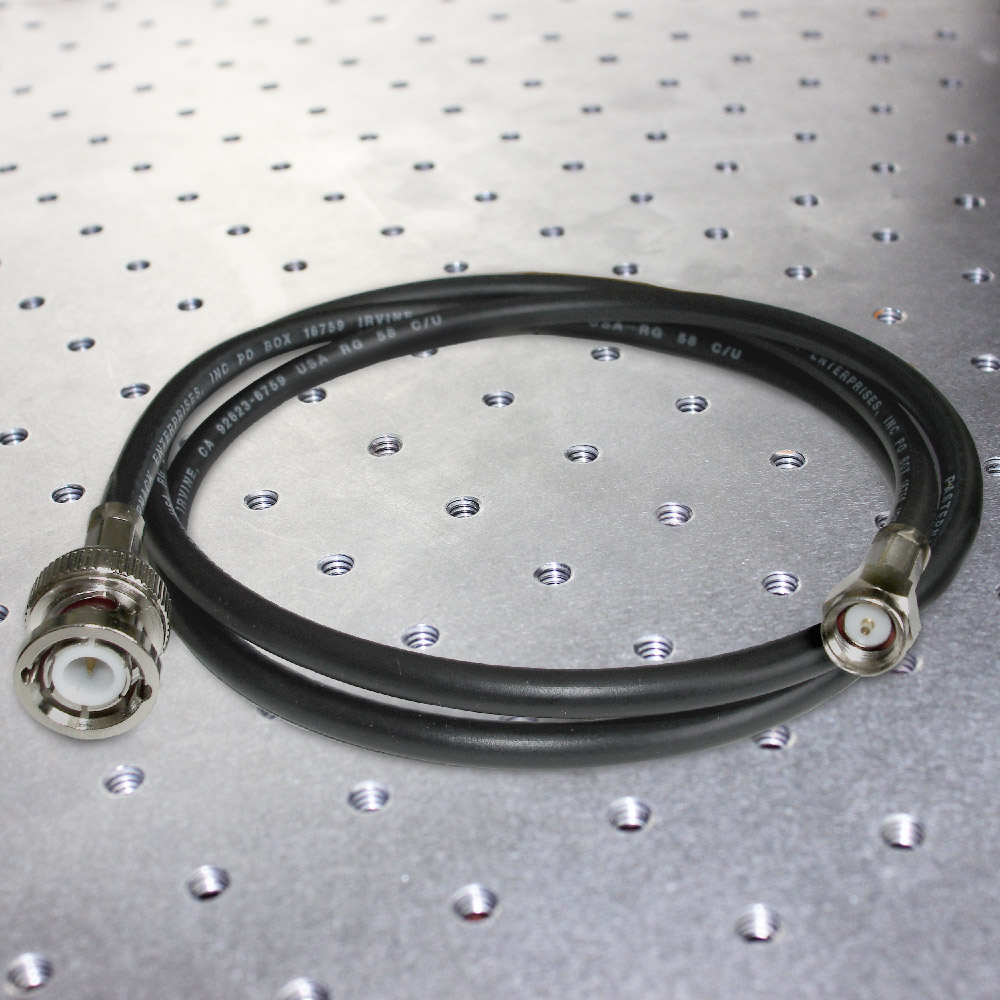 |
| 55-110015 | 3-foot Male-Male USB Cable | $19.00 | 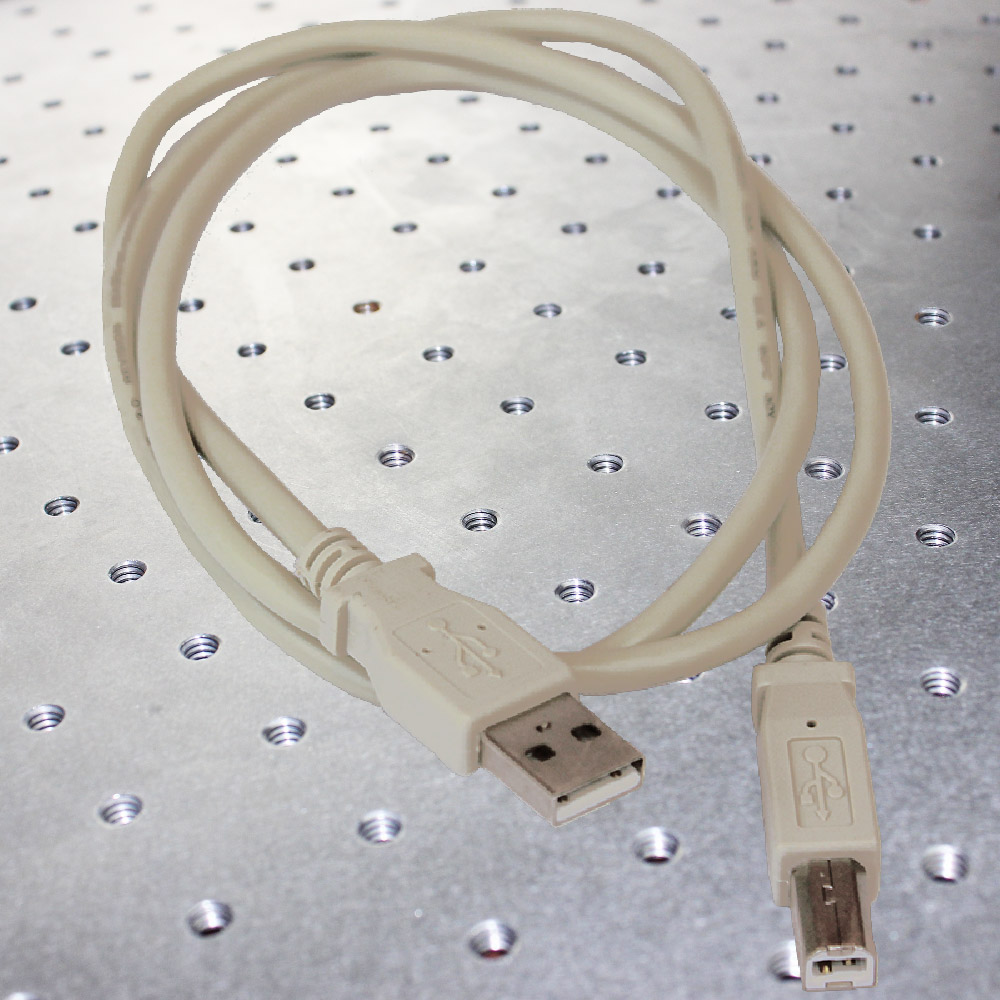 |
| WCB310 | WCB310 SMA to SMA Cable, 36”, male-to-male | $28.00 | 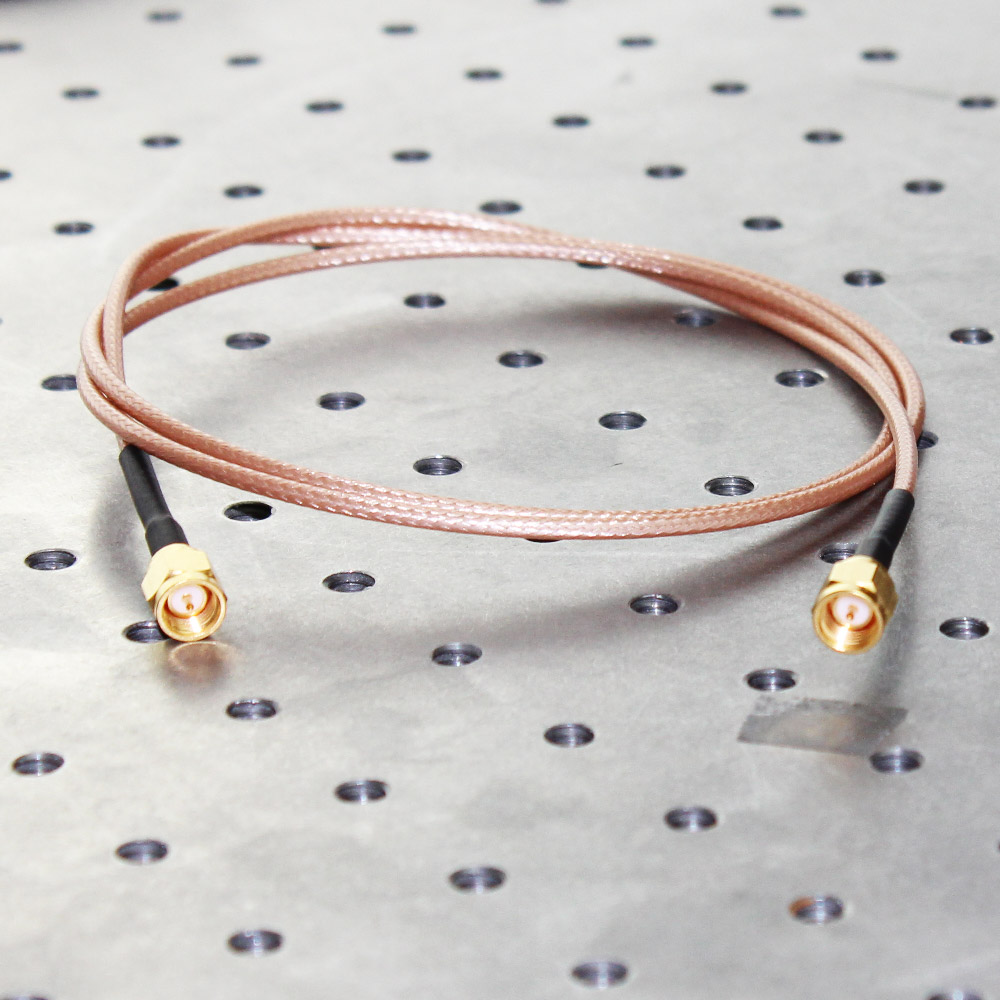 |
| SKU | DESCRIPTION | PRICE | IMAGE |
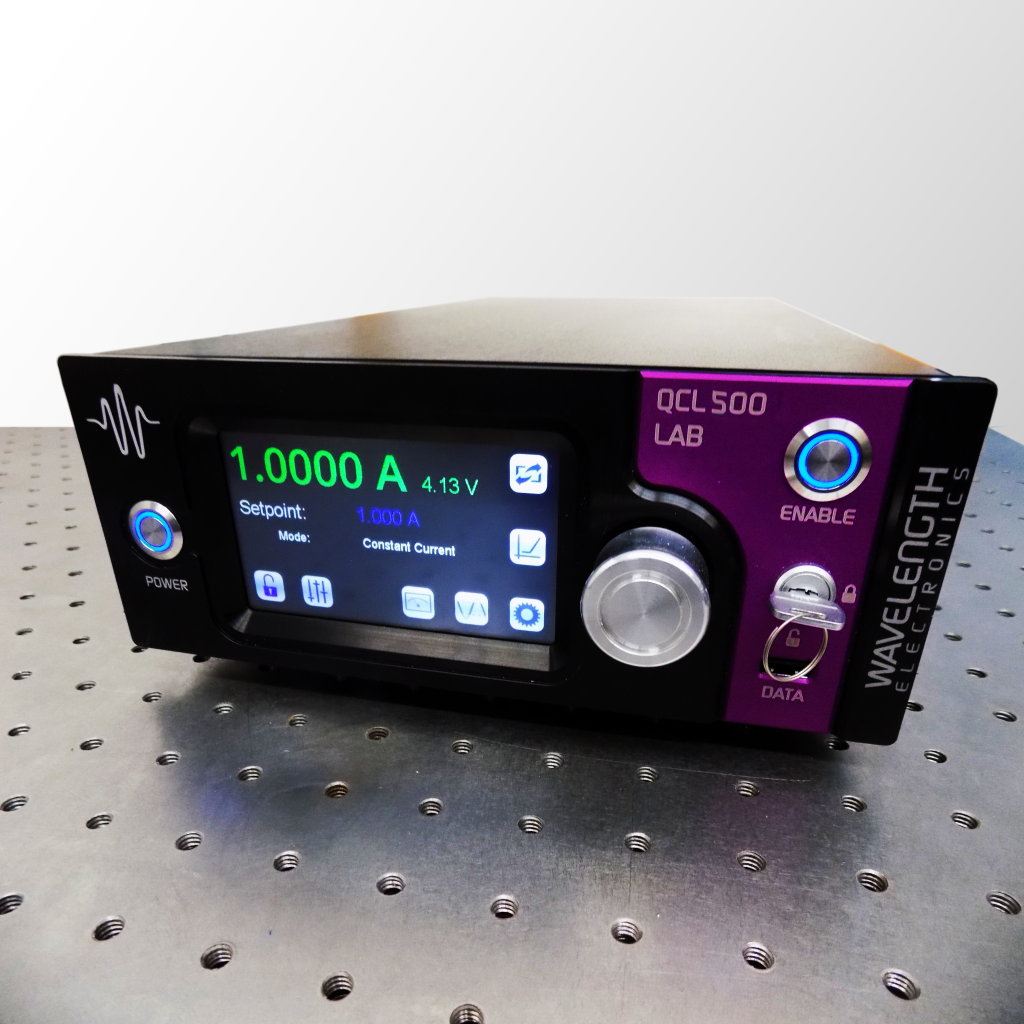
| QCL500 LAB | QCL500 Laboratory Series 500 mA QCL Driver Instrument |
$3,666.00 You save (%) |
 |
| QCL1000 LAB-1.61 | QCL1000 Laboratory Series firmware version 1.61 | $3,648.00 | 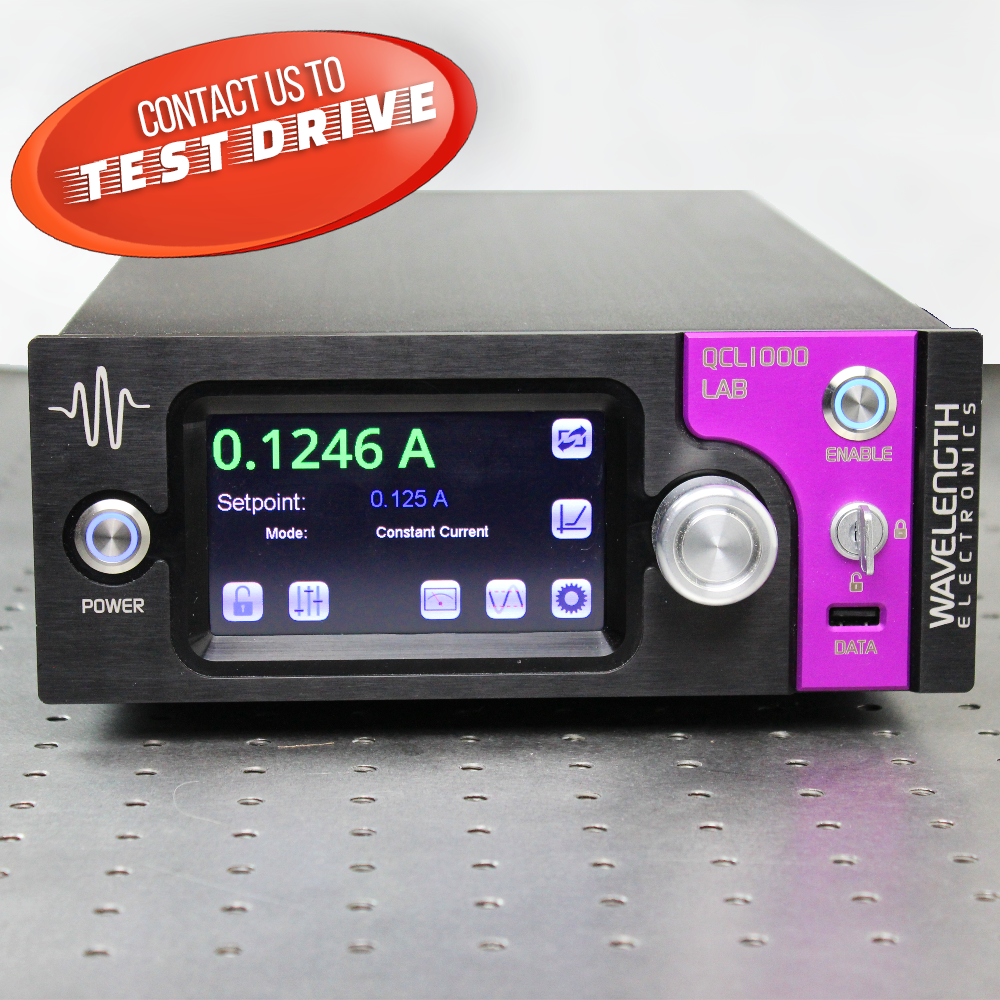 |
| QCL1500 LAB-1.61 | QCL1500 Laboratory Series firmware version 1.61 | $3,778.00 | 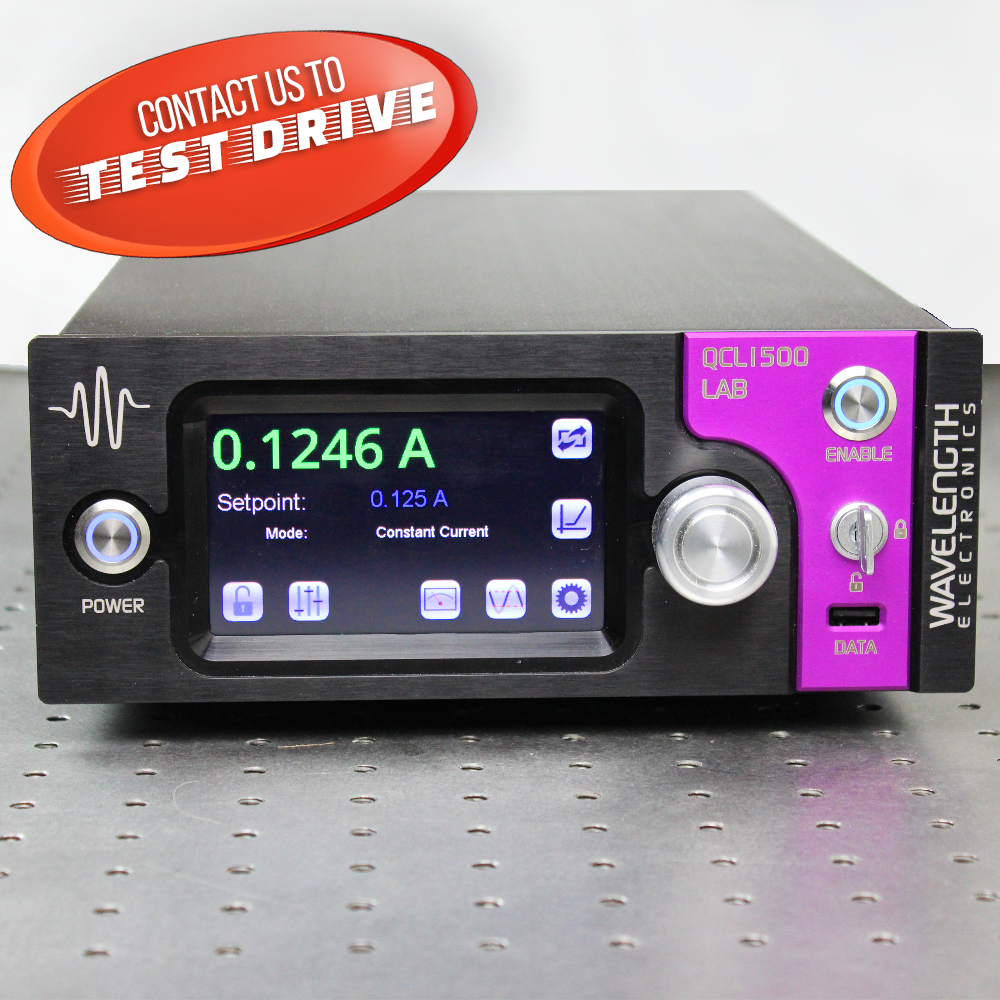 |
| QCL2000 OEM | QCL2000 OEM Low Noise 2 A Quantum Cascade Laser Driver | $2,095.00 | 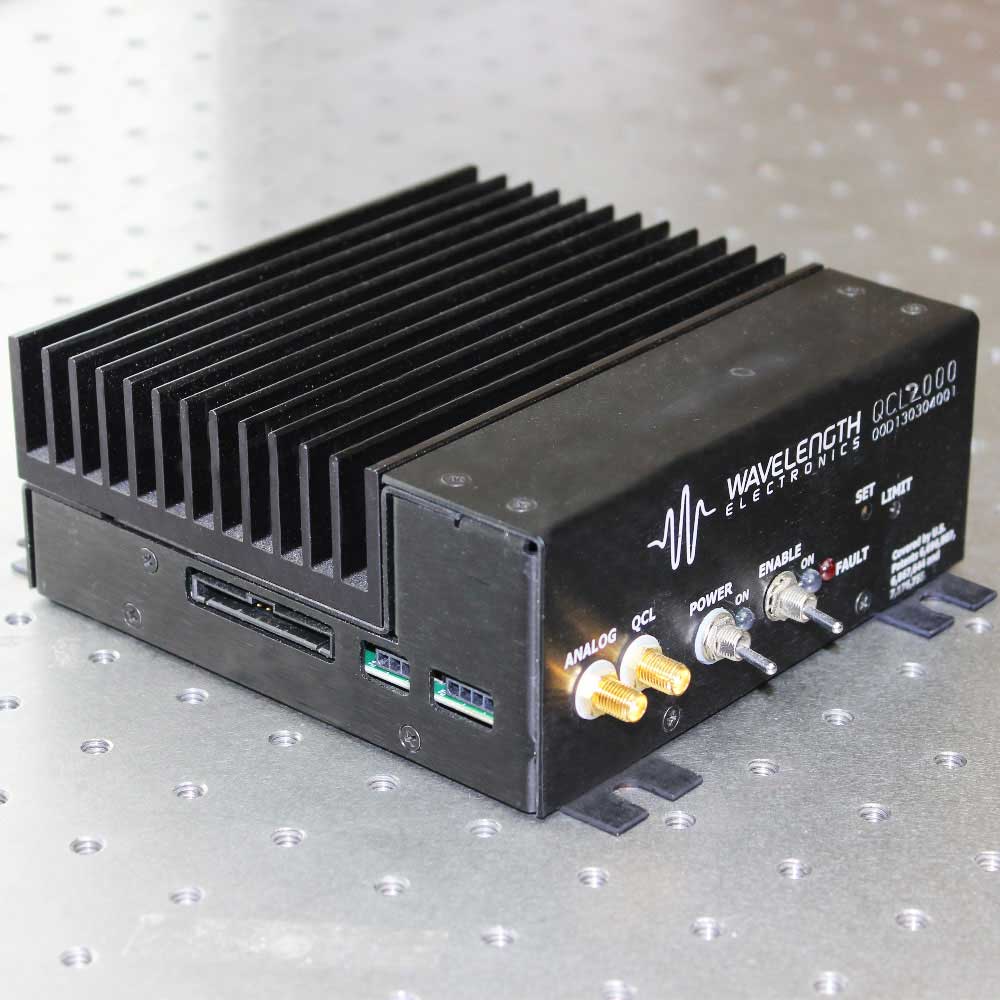 |