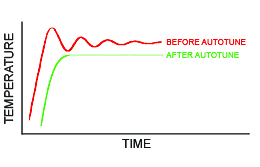
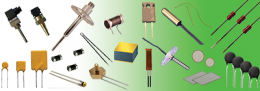
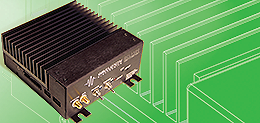
Often, temperature control instruments come with an Autotune function. Each manufacturer boasts their own proprietary algorithm. For maximum temperature stability, the control system parameters need to be matched to the thermoelectric, load, and sensor. Autotune uses the onboard processors to sample the system’s response to changing current and calculates the optimal Proportional Gain (P), Integrator Time Constant (I), and Derivative term (D). Our LFI3751 temperature controller allows two different kinds of optimization: Setpoint Response (AutS) where fastest time to temperature and minimal overshoot is the goal, or Disturbance Rejection (AutD) where maximum temperature stability is the goal despite changing conditions such as in pulsed laser diode systems. The Current Limit setting can be used in conjunction with Autotune to further optimize stability. Setting the current limit at the maximum thermoelectric level can cause overshoot in a fast load or if the AutD is used, leading to a long time to temperature. If you run Autotune at several current limit settings (below the maximum) you can further minimize time to temperature. Note that all PID parameters that Autotune calculates can be translated into settings for any Wavelength linear controller. Contact Technical Support for more information.
The LabVIEW environment is used by many of our partners to automate control systems. Wavelength is certified to develop LabVIEW applications and we have established a core of executable virtual instruments (VI) available at no charge. These have been used in many different applications including laser diode wavelength control via temperature control, fiber laser development, vibration sensing for security systems, laser-based radar systems, and many more. If you would like a VI developed for a different product or would like the *.vi file instead of the *.exe, please contact Technical Support.
Wavelength designed the QCL LAB and TC LAB instruments with the touchscreen interface to be upgradeable in the field. New TCLAB firmware is available – for free. Version 1.7 can be downloaded here. The upgrade gives full access to IntelliTune. For instructions on how to upgrade the firmware, see the datasheet here.
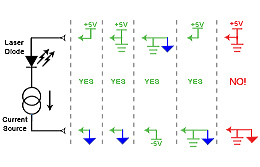
In some medical systems, the laser diode anode must be grounded. In other cases, the cathode must be grounded. There are some systems where the laser diode power supply must be floated so the optical table can be wired to ground to reduce system noise. Adding computer control also complicates grounding. Our Application Note AN-LD16: Grounding with Special Laser Diode Configurations discusses these situations and offers guidance for implementing them.
We invite you to contribute topic suggestions, questions, and general feedback. Wavelength will incorporate as much reader input as possible. Click to Submit
Lisa Mueller
Marketing Communications: Showing the beauty and clarity of laser electronics.