Wavelength Electronics Named Prospera Business Network Innovator of the Year Finalist. See VIDEO

November 14, 2016

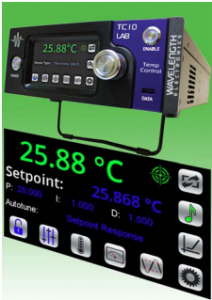
Wavelength Electronics is proud to have been selected as a Finalist for the Prospera Business Network 2016 Innovator of the Year award. We were nominated for our new TC LAB Series benchtop temperature controller with intuitive touchscreen, IntelliTune® control, and 0.0009°C stability.

About Prospera Business Network: Prospera is a nonprofit economic development organization built on the foundation of our members’ participation and financial support. We facilitate business leadership with a constant goal to advance, challenge and inspire our regional business communities. Prospera has been successfully working to improve the local economy for over 30 years. Prospera offers a variety of small business resources designed to facilitate growth and development, allowing you to effectively compete in global commerce while enjoying mountain vistas, blue ribbon trout streams, rare wildlife and neighborly communities. Services include small business loans, relocations services, economic research, and educational programs.

Watch the nomination video:

NEW VIDEO: Focus on PTC Series

September 2, 2016

This video will help you understand the PTC Series Temperature Controllers and how to quickly set one up for your application.

NEW — PRECISION TEMPERATURE CONTROL INSTRUMENTS

June 27, 2016

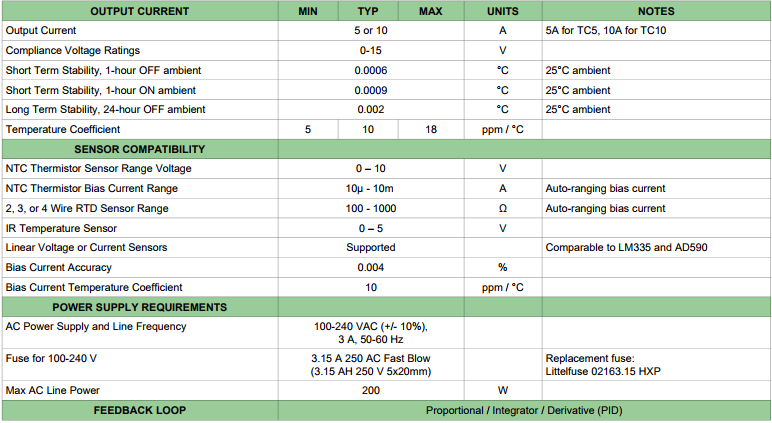
The TC10 (10A, 15V) and TC5 (5A, 15V) are ultra-stable digital controllers for thermoelectrics and resistive heaters where tight temperature stability is required.
Designed using the latest technology, stabilities better than 0.0009°C can be achieved with thermistors. High stability enables researchers to precisely monitor trace gases in fracking, bio-samples in life-sciences, and semiconductor performance. Tight control enables applications in electro-optics, imaging, spectroscopy, remote sensing, military, aerospace, communications, material procesing, and environmental or manufacturing control.

ULTRA-STABLE TEMPERATURE CONTROLLER
These best-in-class temperature controllers offer:

  • Excellent stability (0.0009°C) at 5 & 10 Amps up to 15 Volts
  • Intuitive touchscreen front panel – see setpoint, actual temperature, stability status all on one screen!
  • Extra safety – shut down your laser / QCL / active load if it goes outside user set temperature limits. Auxiliary sensor can monitor heat sink temperature.
  • Expanded Remote Command set – control and log data from a remote computer via USB (Test & Measurement class) or Ethernet
  • Autotune optimizes PID control values to minimize time to temperature or reject external disturbances
  • Active Autotune keeps adapting the PID control values as setpoint is changed
  • Interface with the NEW IR Sensor to monitor temperature of liquids and solids REMOTELY, avoiding contact or contamination with the sample.
  • Compatible with all sensors – thermistor, RTD, LM335, AD590.

SAFETY IS BUILT IN
Over and under temperature limits as well as positive and negative current limits can be set. If the sensor signal is lost or a short is detected at the thermoelectric, output current is disabled. If temperature limits are exceeded, a signal to the active laser load can be sent to disable its current. For example, connect the LD Shutdown BNC output to the Active Lock input on Wavelength’s QCL LAB driver and the QCL current will shut down if temperature limits are exceeded. An Auxiliary Sensor can be used to monitor the temperature of the system heatsink.

ACTIVE AUTOTUNE
Instead of long, manual calculations to derive the optimal Proportional, Integral, and Derivative [PID] control terms for a load, press the Autotune icon and the instrument will automatically cycle through a characterization test to tune the control terms for best performance. Two methods of Autotune are available. Setpoint Response optimization will minimize the time to temperature for the load. Disturbance Rejection optimization is best when there will be significant changes to the ambient temperature or operating condition. This could be for a pulsing laser diode where the active heat load changes or a sample that is to be tested in changing ambient temperatures.

SPECIFICATIONS


NEW VIDEO: Focus on PLD Series

May 24, 2016

This video will help you understand the PLD Series Laser Diode Drivers and how to quickly set one up for your application.

Sections include:
0:19 Overview of Different PLD Models
1:41 Theory of Operation
3:15 Calculate Safe Operating Area (SOA) Criteria
3:43 Necessary Equipment
4:14 +5V Operation
4:43 Example of Higher Voltage Operation
7:43 External Modulation
9:27 Example of Constant Power Mode Operation
11:11 Differences with the 12.5A Models
11:28 USBKIT

Low Noise QCL Driver Available for Reverse Polarity

March 30, 2016

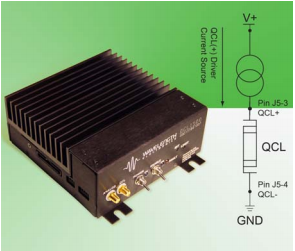
The low-noise QCL OEM driver has enabled countless applications with its patented circuitry. Now, the reverse polarity driver, a current source, is available in the OEM package. Often with epi-down configurations of the QCL the exit lead is attached to the case and it is desirable to ground it. While floating both connections would make it possible to use the standard QCL OEM, simply use the QCL OEM(+) and ground the connection. The Analog Input for remote setpoint input operates at 0 to +5V input, with bandwidth up to 1-2 MHz for the QCL500(+) and 500 kHz for the QCL2000(+).

These Low Noise QCL OEM(+) Series Drivers have the lowest current noise density of any commercially available driver. Powering your QCL with this driver will enable better performance—at lower cost and in less time—than otherwise possible. This is the right driver for QCLs that require a high precision and ultra-low noise current source. The 500 mA QCL OEM(+) driver exhibits noise performance of 0.5 μA RMS to 100 kHz, and an average current noise density of 1.5 nA / √Hz.

LOW NOISE FOR ULTRA-NARROW LINEWIDTHS

Two key characteristics of quantum cascade lasers make them popular for precision sensing and spectroscopy applications: 1) the wavelength can be custom-tailored to mid- and long-wavelength IR, and 2) the extremely narrow linewidth allows for faster, higher-precision, and more repeatable measurements than competing technologies.
Quantum cascade laser linewidth is key to precision sensing applications, and trace gas concentration measurement sensitivity in the parts-per-trillion can be achieved with careful system design. All aspects of the detection system must be designed and executed with precision in order to achieve such capability, and the QCL driver and supporting electronics play a particularly important role.
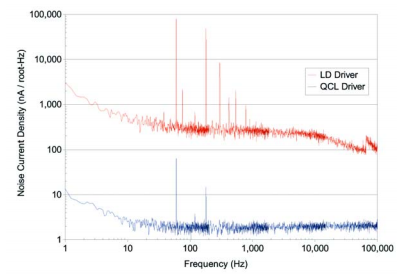
The figure on the left illustrates the noise spectrum of the QCL1000 over a 100 kHz bandwidth, at an output current of 500 mA, and compares it to a typical benchtop laser diode driver. A 10 Ω test load is used in order to operate the driver at a higher compliance voltage, a more stringent test of noise performance. Laser emission wavelength and linewidth are both partly a function of current density, and therefore drive current noise and jitter manifest directly as broadened linewidth and wavelength jitter. Broadening the center wavelength by a fraction of a cm-1 can reduce measurement sensitivity by an order of magnitude or more, so it is critical to approach the entire design process with an attitude towards eliminating noise.


During manufacturing, we test spectral noise density across a wide bandwidth using a load that effectively simulates a QCL. This test is more stringent than stating a single RMS noise value, and provides a more meaningful statement of noise performance. This attention to detail guarantees the driver meets or exceeds our own strict internal specifications.
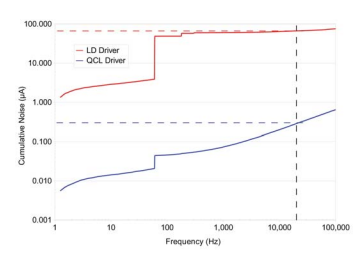
The figure on the right shows the cumulative noise density, determined by integrating the noise data from Figure 1. To determine the cumulative noise over a 1 Hz – 11 kHz bandwidth, for example, simply refer to the noise value at 11 kHz. The QCL exhibits 0.3 μA, while the laser diode driver exhibits 60 μA over the same bandwidth.

APPLICATIONS
Due to their unique construction, QCLs operate with high power in the near-IR through terahertz ranges. These wavelengths are particularly suited to detection of molecules significant to humans. Applications for the lower noise QCL driver include: remote detection of explosive materials, medical diagnosis using the breath, non-invasive glucose testing, emissions monitoring of the atmosphere or marine environments, and pharmaceutical process quality control. Additional applications include anesthesia and hospital air quality monitoring, leak detection, and remote imaging.
Wavelength Electronics QCL LAB Series Instrument Voted 2015 R&D 100 Award Winner

November 30, 2015

The editors of R&D Magazine have announced the winners of the 53rd annual R&D 100 Awards, an international competition honoring the 100 most technologically significant products introduced into the marketplace over the past year.
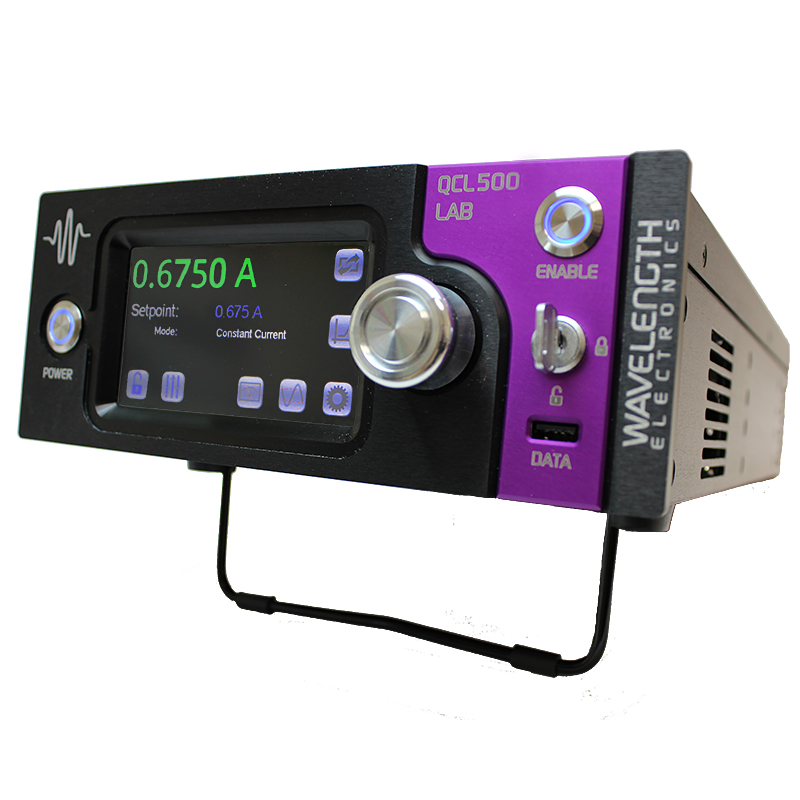
The QCL LAB Series Instrument was selected winner in the Analytical/Test category.

The R&D 100 Awards recognize excellence across a wide range of industries, including telecommunications, optics, high-energy physics, materials science, chemistry, and biotechnology. The awards not only recognize the efforts of the development team and partners, they provide a mark of excellence known to industry, government, and consumers.

We are pleased to have been chosen from among the 300+ R&D 100 Award Finalists recognized for high achievement within the categories Analytical/Test, IT/Electrical, Mechanical/Materials, Processing/Prototyping, and Software/Services.

About the R&D 100 Awards:
Since 1963, the R&D 100 Awards have identified revolutionary technologies newly introduced to the market. Widely recognized as the “Oscars of Invention,” the R&D 100 Awards identify and celebrate the top technology products of the year. Past winners have included sophisticated testing equipment, innovative new materials, chemistry breakthroughs, biomedical products, consumer items, and high-energy physics spanning industry, academia, and government-sponsored research.

About the QCL LAB Series Instruments:

The Wavelength Electronics QCL driver provides the lowest possible detection thresholds for QCL-based sensors. At 0.4µA RMS noise current and 1nA / √Hz average current noise density up to 100kHz (500 mA model), it’s the lowest commercially available. Low electronic noise translates into stable center wavelength, narrow linewidth, and repeatable scans.

Models are available with output currents of 500 mA, 1000 mA, 1500 mA, and 2000 mA in Constant Current mode. Compliance voltage is adjustable up to 20 V with 2-3 MHz analog modulation bandwidth. Application notes and free technical support help you minimize noise in particularly demanding applications.

The instruments offer an intuitive touchscreen, maximum safety, and remote USB or Ethernet control. Perfect for benchtop or rack mount research.

For more information on the award winning QCL LAB Series, check out the QCL500 LAB.

OKI Advanced Package Rework (APR) System for Sale from Wavelength Electronics

October 8, 2015

This system (Model: APR-5000-DZ-ML) was purchased in 2008.
  • It was lightly used for one year and has sat idle since then.
  • It is in good condition.
  • All the accessories that came with the unit are included.
  • The computer (with keyboard and mouse) loaded with operating software is included.
  • A monitor is not included.
  • The unit and computer were fully functional the last time we used them.
Wavelength is offering this system for $9000 and buyer pays shipping.

Is it time to expand your manufacturing service capabilities?
Tired of scrapping boards because you can’t remove the components?
This system can solve your problems for a fraction of new system cost!

Wavelength Electronics Named R&D 100 Award Finalist

July 29, 2015

Wavelength Electronics is proud to have been selected as a Finalist for the 53rd annual R&D 100 Awards in the Analytical/Test category for the QCL LAB Series Low Noise Quantum Cascade Laser Driver. The complete list of categories and finalists can be found here.

About the Awards: The R&D 100 Awards seeks to honor the 100 most innovative technologies and services of the past year. The Finalists were selected by an independent panel of more than 70 judges. This year’s Finalists represent many of industry’s leading organizations and national laboratories, as well as many newcomers to the R&D 100 Awards, often referred to as the “Oscars of Invention.”

“This was a particularly strong year for research and development, led by many outstanding technologies that broadened the scope of innovation,” said R&D Magazine Editor Lindsay Hock. “We are honored to recognize these products and the project teams behind the design, development, testing, and production of these remarkable innovations and their impact in the field. We look forward to celebrating the winners in November.”

CEO: The Future of the QCL Industry

June 4, 2015

Wavelength Electronics CEO, Mary Johnson, joined Photonics Spectra Contributing Editor Justine Murphy and a panel of QCL manufacturers in a discussion of the future of the QCL Industry. The consensus is growth and opportunity.

The whole article can be found here.