NEW! Low Noise Quantum Cascade Laser Driver

February 1, 2011

Improve Your Chemical Sensor Performance

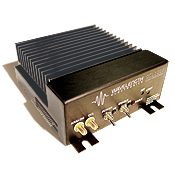
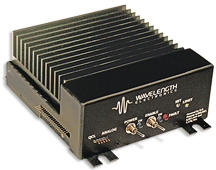
Minimize linewidth, spectral drift, and center wavelength jitter with low noise control electronics. The QCL Series of Low Noise Quantum Cascade Laser Drivers offers sub-microamp RMS noise. [0.7 mA RMS over 100 kHz bandwidth with the QCL1000 1 A driver.] Designed as an OEM controller, it can be used in field-deployed systems or on a benchtop. Bandwidth is 2-3 MHz, with rise and fall times of 250 / 200 nsec.

The QCL Series drives up to 2 A of low noise current with core safety features – current limit, slow start, brownout / reverse voltage / overvoltage protection, remote or local current enable. Even though it is lower cost than an instrument, it is smaller and offers significantly better performance. Application notes and free technical support help you minimize noise in particularly demanding applications. Wavelength Electronics has simplified advanced laser diode drive and thermal control technology for OEM and research applications since 1993. Our high performance specifications are supported by a team of experienced sales and design engineers and a top-notch manufacturing facility. Evaluation quantities are typically available from stock.

NEW! RHM5K-CH Precision Unipolar Temperature Controller

January 18, 2011

Small, Simple, Low Cost PID Control with < 0.003ºC Stability

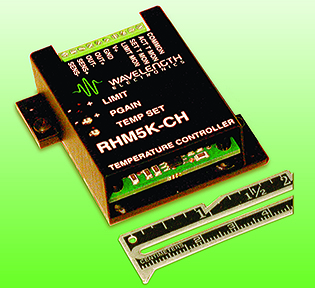
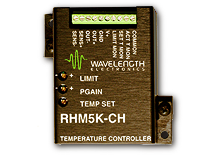
The RHM5K-CH can be used to achieve precision control at off-ambient temperatures. The PID control loop drives resistive heaters or thermoelectric coolers. The RHM offers a high level of stability and can supply up to 5 A with a small footprint. On-board 12-turn trimpots control temperature setpoint, proportional gain, and output voltage limit. A single 10-pin terminal strip provides easy access to the DC supply, sensor, resistive heater, and measurement connections.

The RHM features:

  • Compact, 5 A Drive Current
  • <0.003 °C stability (24-hour)
  • Single Supply Operation +5 V to +30 V
  • Voltage Limit
  • >+27 V compliance with +30 V input
  • Supports Thermistors, IC sensors or RTDs
  • PID Control Loop
  • Temperature Setpoint, Proportional Gain, and Limit Voltage are user adjustable
  • Easy operation for resistive heater or thermoelectric

The RHM5K-CH is suited for applications where heating or cooling (not both) is required. This product is ideal for applications where temperature stability is critical and space is tight, such as heated optics (noncondensing circumstances), CCDs, preheated liquids and chamber stabilization.

Wavelength Electronics has simplified advanced laser diode drive and thermal control technology for OEM and research applications since 1993. Our high performance specifications are supported by a team of experienced sales and design engineers and a top-notch manufacturing facility. Evaluation quantities are typically available from stock.

To learn more about the RHM5K-CH Precision Unipolar Temperature Controller and Wavelength’s complete line of high precision, low-noise, ultra-stable laser diode drivers and temperature controllers, call 406-587-4910 or email sales@teamwavelength.com.

New Products Introduced at Photonics West 2011

December 16, 2010

Visit the Wavelength Electronics booth, #2200 South Hall, for a first look at the new QCL Series Quantum Cascade Laser Drivers and the RHM5K-CH Precision Unipolar Temperature Controller. Several products have also been upgraded – talk to our Application Engineers for details of the improvements and expert technical advice on maximizing Wavelength product performance in a specific application.

Ideal for precision chemical sensors, the QCL Series Low Noise Quantum Cascade Laser Driver includes patented circuitry designed for driving QCLs where electronic noise, coupled through the laser, affects sensor measurement. It is proven to minimize linewidth, spectral drift, and center wavelength jitter. Safety features include: current limit; brownout, reverse voltage, and overvoltage protection; Overtemp Shutdown; onboard or Remote Enable.

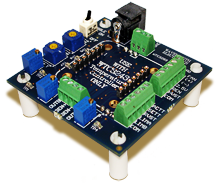
The RHM5K-CH Precision Unipolar Temperature Controller offers a high level of stability and can drive up to 5 A with a small footprint. The RHM uses a PID control loop to power resistive heaters or thermoelectric coolers with all sensor types. It can be used to achieve control at off-ambient temperatures. On-board trimpots control temperature setpoint, proportional gain, and output voltage limit. The RHM5K-CH is suited for applications where stability is critical and space is tight, such as heated optics (non-condensing circumstances), CCDs, preheated liquids and chamber stabilization.

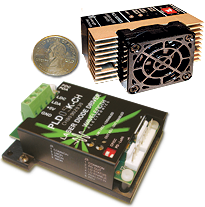
The popular PLD Series Laser Diode Driver is now available as a 6.5 A model and the PLD-CH as a 12.5 A model. Output current has been increased and noise has been reduced in the PLD product lines. Delivering the precision control you expect from a Wavelength component with improved bandwidth and higher output current, the PLD12.5K-CH is a chassis mount controller and the PLD6500 is a plug-and-play PCB mount controller. Both have onboard setpoint and limit controls, remote enable/disable, Active Current Limit, and maximized laser diode protection. These versatile controllers are ideally suited to: material processing, industrial control, biomedical, spectroscopy, environmental, semiconductor, aerospace/military, communication, and remote sensing.

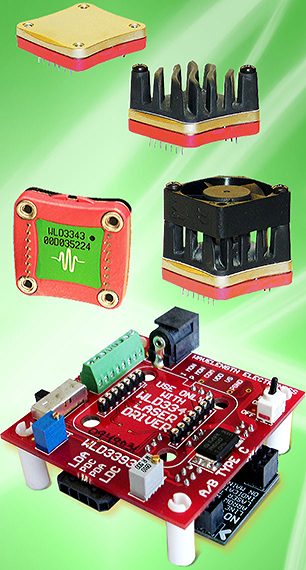
The WLD3343 Series has been enhanced for higher output current, lower noise, and no leakage current. It is now available up to 3 A in a 14-Pin DIP package. The WLD3393 Evaluation Board has been updated to support all the improvements. The WLD3393 is frequently designed into OEM systems using fixed resistors to eliminate trimpots and minimize thermal drift. Our Application Engineers are available to discuss configuration options appropriate to your system.

The WTC3293 Evaluation Board has been upgraded to improve performance and simplify design integration of the WTC3243 Temperature Controller for on-ambient sensing applications.

Our Application Engineers will be present to answer questions, brainstorm solutions to difficult design problems, and to accept feedback of any kind. Wavelength Electronics exists to support the design efforts of the OEMs and researchers in laser and temperature control.

Upgraded Laser Diode Driver – Now up to 3 A

July 8, 2010

Fast Control System Prototyping with the Improved WLD3393 Evaluation Board

The highly popular WLD3343 General Purpose Laser Diode Driver has been upgraded for higher output current, lower noise, and no leakage current. It provides up to 3 A output in a compact 14-pin DIP package. The WLD3343 Series is ideal for a wide variety of electro-optical instrumentation, including spectrometers, medical diagnostic equipment, range finders, and on research benches. The upgraded WLD3393 Evaluation Board allows fast system design.

The upgraded WLD3343 is available in five models:

  • The standard 2.2 A (WLD3343)
  • A 2.2 A lithium-ion battery-compatible (WLD3343HB)
  • A 2.2 A lower noise version (WLD3343-2L)
  • The 3 A enhancement (WLD3343-3A)
  • A lower noise 3 A version (WLD3343-3L)

The WLD3343 is an analog circuit for space-constrained designs that supplies up to 2 MHz modulation bandwidth, current limiting, and Constant Current or Constant Power operation with any laser diode configuration. To protect your laser diode and ensure reliable performance, safety features including slow start, voltage-controlled setpoint, TTL-compatible shutdown, and over-temperature shut-off have been incorporated into the design. Since the maximum current output is scaleable, the WLD3343 can safely be used with low current VCSELs.

The WLD3393 Evaluation Board operates from a single supply and is compatible with all standard laser diode configurations. Onboard switches, connectors and trimpots make fine-tuning of the laser diode forward current and limit easy and accelerate product design. Online design tools, including a Circuit Design Calculator and Safe Operating Area Calculator, are available at www.teamwavelength.com/support/tools.asp.

Wavelength Electronics has simplified advanced laser diode drive and thermal control technology for OEM and research applications since 1993. Our high performance specifications are supported by a team of experienced sales and design engineers and a top-notch manufacturing facility. Evaluation quantities are typically available from stock.

To learn more about the WLD3343 Laser Diode Drivers, WLD3393 Evaluation Board Upgrade and Wavelength’s complete line of high precision, low-noise, ultra-stable laser diode drivers and temperature controllers, call 406-587-4910 or email sales@teamwavelength.com.

Precise Trace Gas Analysis – Without the Noise

[vc_row][vc_column][vc_column_text]May 24, 2010

Frances White, PNNL, (509) 375-6904

PNNL technology refines laser sensors, licensed to Wavelength Electronics

RICHLAND, Washington – Analyzing trace atmospheric gases can now be considerably more precise with the help of a device that delivers stable and reliable power to the lasers used in gas sensors.

The low-noise current controller was developed at the Department of Energy’s Pacific Northwest National Laboratory. The technology was recently licensed to Bozeman, Montana-based Wavelength Electronics Inc. by Battelle, which operates PNNL for DOE.

“Low-noise current controllers open up new ways for us to analyze trace gases,” said Matthew Taubman, a PNNL scientist who developed the device. “Now we can evaluate significantly smaller gas concentrations.”

Scientists often analyze atmospheric gas concentrations with laser-based sensors. Researchers sample air at sites of interest, such as on the ground near power plants or at high altitudes from airplanes. The sensor instrument then directs a laser through the sample. Based on how much laser light is absorbed by the sample, scientists can determine the specific gases present and their concentrations.

But smaller concentrations of certain gases can be challenging to analyze. One particular problem occurs when “noises,” or random fluctuations, exist in a laser’s wavelength and line width. Such noise prevents researchers from making precise readings.

PNNL scientists reduced this problem by developing a low-noise current controller. The device reduces the noise on the laser’s power source, allowing scientists to detect smaller levels of trace gases. PNNL’s controller is the lowest noise controller on the market that was specifically designed for extra-sensitive sensors that use quantum cascade lasers, also called QCLs. Sensors made with QCLs emit light in a wavelength region that many trace gases strongly absorb. QCL-based sensors become even more sensitive when they are powered with low-noise current controllers like PNNL’s.

Wavelength Electronics already develops compact current controllers and related components for a variety of semiconductor lasers. Wavelength CEO Mary Johnson also recognized there was a strong potential for her company to make similar QCL-friendly components for Wavelength’s customers – original equipment manufacturers, or OEMs.

That prompted Wavelength to request support through PNNL’s Technology Assistance Program, which pairs small businesses looking to overcome specific technology challenges with PNNL scientists. Through the program, Taubman – the researcher who developed PNNL’s low-noise current controller – compared Wavelength controllers to PNNL low-noise controllers.

At the same time, PNNL and Wavelength brought PNNL’s low-noise controllers to one of Wavelength’s customers, sensor systems manufacturer Aerodyne Research Inc. of Billerica, Massachusetts. Aerodyne tested the low-noise controllers and learned the devices provided the sensitivity their QCL-based sensors needed. This convinced Johnson that licensing PNNL’s controllers would speed up Wavelength’s entry into the QCL-based sensor market.

“There’s a tremendous need for this technology right now and Wavelength Electronics is pleased to be able to offer it to trace gas researchers and analytical instrument manufacturers,” Johnson said.

Wavelength is looking to launch products that incorporate PNNL’s low-noise current controller technology by the end of this year. The products will specifically target the QCL market. But other models will be available to work with laser diodes that could be used in microbial detection, skin cancer scanning, DNA sequencing, remote measurements and testing with VCSELs, or vertical cavity surface-emitting lasers, a kind of laser diode.

But Aerodyne didn’t want to wait until Wavelength released its new products. Soon after the license went through, Wavelength made the sensor system manufacturer a copy of the low-noise controller for immediate use. Aerodyne is now using these controllers with their most demanding sensor applications, those with continuous-wave QCLs.

REFERENCE:

Wavelength Electronics has simplified advanced laser diode drive and thermal control technology for OEM and research applications since 1993. Wavelength delivers instrument-level performance in small, cost-effective modules. To learn more about Wavelength’s line of high-precision, ultra-stable diode drivers and temperature controllers, send an e-mail to quietqcl@teamwavelength.com.

Pacific Northwest National Laboratory is a Department of Energy Office of Science national laboratory where interdisciplinary teams advance science and technology and deliver solutions to America’s most intractable problems in energy, national security and the environment. PNNL employs 4,700 staff, has an annual budget of nearly $1.1 billion, and has been managed by Ohio-based Battelle since the lab’s inception in 1965. Follow PNNL on Facebook, LinkedIn and Twitter.[/vc_column_text][vc_row_inner][vc_column_inner width=”1/3″][vc_single_image image=”3152″ img_size=”full” add_caption=”yes”][vc_column_text]PNNL staff developed this low-noise current controller to deliver stable power to sensors that use quantum cascade lasers to analyze very small gas concentrations. Wavelength Electronics recently licensed the technology and plans to release its own line of products based on it.[/vc_column_text][/vc_column_inner][vc_column_inner width=”1/3″][vc_single_image image=”3153″ img_size=”full” add_caption=”yes”][vc_column_text]Scientists can analyze atmospheric gas concentrations with laser-based sensors that use systems similar to the one illustrated above. The sensor instrument directs a laser through gas and, based on how much laser light is absorbed by a sample, scientists can determine the specific gases present and their concentrations.[/vc_column_text][/vc_column_inner][vc_column_inner width=”1/3″][vc_single_image image=”3154″ img_size=”full” add_caption=”yes”][vc_column_text]Using PNNL technology, Aerodyne Research experienced extremely low jitter, excellent reproducibility with trace to trace averaging, highly stable baselines and low parts-per-trillion detection limits on its formaldehyde and carbonyl sulfide detection system.[/vc_column_text][/vc_column_inner][/vc_row_inner][/vc_column][/vc_row]

New Products at Photonics West 2010, #2202 South Hall

December 28, 2009

Visit the Wavelength Electronics booth, #2202 South Hall, for product premieres, details on several upgraded models, general information, and expert technical advice on maximizing Wavelength product performance in a specific application.

The popular PLD Series Laser Diode Driver is now available as a 6.5 A model. Delivering the precision control you expect from a Wavelength component with improved bandwidth and higher output current, the PLD6500 is a plug-and-play PCB mount component with onboard setpoint and limit controls, remote enable/disable, Active Current Limit, and maximized laser diode protection. This versatile controller is ideally suited to: material processing, industrial control, biomedical, spectroscopy, environmental, semiconductor, aerospace/military, communication, and remote sensing.
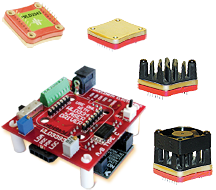
Wavelength now offers a 3 A laser diode driver in a 14-Pin DIP package, P/N WLD3343-3A. Our Application Engineers would be happy to discuss whether this version is appropriate for your design. The 2.2 A WLD3343 noise specification has been reduced, and the WLD3393 Evaluation Board has been updated to support all the improvements.

In 2009, Wavelength launched a new website, designed by engineers for engineers. For access to specifications and datasheets for our precision laser diode drivers and temperature controllers just click Support -> Datasheets and select the datasheet you want. More detailed technical information has been added – tutorials, application notes, FAQs, 3-D models, references and industry links. Online design tools have also been enhanced. A Safe Operating Area (SOA) calculator simulates the thermal requirements of your particular design. Circuit Calculators for the WLD laser diode driver and WTC temperature controller chips quickly determine values for all external components based on your application input values. A selection guide compares the core specifications of both laser diode drivers and temperature controllers, accessed with a single click of the Products button.

Our Application Engineers will be present to answer questions about the products and integration in specific applications, to brainstorm solutions to difficult design problems, and to accept feedback of any kind. Wavelength Electronics exists to support the design efforts of the OEMs and researchers in laser and temperature control. Let us know what you need, so we can help you achieve your goal!

PTC Failsafe Default Mod – New Application Note

November 16, 2009

The PTC Temperature Controllers have a feature that is meant to protect a laser diode (or other hardware you’re thermally stabilizing) in the event that the remote setpoint signal is lost. With NTC sensors, a 0 V setpoint equates to a “hot” temperature. If the setpoint signal is lost, the controller will drive heating current (at current limit) to match the sensor voltage to the 0 V setpoint. This can potentially cause excessive temperatures at the laser diode.

The failsafe circuit substitutes a “safe” default setpoint voltage when the setpoint voltage drops below a limit. In the factory default configuration, the minimum setpoint is approximately 0.3 V. The substitute setpoint is approximately 1.0 V. This correlates to a setpoint of about 25°C, assuming the system is using a 10 kΩ thermistor and a 100 µA bias current through the thermistor. Since room temperature is typically 25 °C, this is usually a “safe” temperature setpoint default. Both the trip point and the substitute setpoint can be modified to meet the specific requirements of your application.

Application Note AN-TC07 describes how to configure these parameters.

Please be aware that circuit modifications implemented by the customer will void the Wavelength Electronics warranty. Only factory implemented modifications are warrantied. For factory service please contact Wavelength or an authorized distributor.

HTC Series Upgraded – Better Temperature Stability

August 28, 2009

The popular HTC Series Precision Temperature Controller has been upgraded to offer better temperature stability and reduced internal voltage drop, leading to improved operating efficiency.

Stability is a measure of how close the actual load temperature stays to setpoint temperature over time. Often there can be a “dead band” when scanning across ambient temperature, during the transition between heating and cooling control. Wavelength Electronics has devoted significant research efforts into making the upgraded HTC immune to ambient crossover. Short term off-ambient stability is 0.0009°C. Long term off-ambient stability is 0.0015°C. On-ambient stability of 0.002ºC has been achieved with thermistors. A Technical Note on How Temperature Stability is Measured, TN-TC02 is available.

The low profile package is ideal for designs with space constraints. It provides up to 3 A of heating or cooling current for medical, defense, communications, or manufacturing applications. The linear, PI (Proportional, Integral) control loop offers maximum stability while the bipolar current source has been designed for higher efficiency. Optimized for ultrastable thermoelectric temperature control applications, the HTC maintains precision temperature regulation using an adjustable sensor bias current and error amplifier circuit that operates directly with thermistors, RTDs, AD590, and LM335 type temperature sensors.

External components configure Limit Current, Temperature Setpoint, Proportional Gain, Integrator Time Constant, and Sensor Bias Current. Buffered measurement outputs are provided to compare Actual with Setpoint temperature, while an Analog Input allows remote control of the setpoint. An evaluation board is available to expedite prototyping.

Wavelength Electronics has simplified advanced laser diode drive and thermal control technology for OEM and research applications since 1993. Our high performance specifications are supported by a team of experienced sales and design engineers and a top-notch manufacturing facility. Evaluation quantities are typically available from stock.

To learn more about the improved HTC Series Temperature Controllers and Wavelength’s complete line of high precision, low-noise, ultra-stable laser diode drivers and temperature controllers, call 406-587-4910 or email sales@teamwavelength.com.

Manufacturing Capacity Enhancements

July 15, 2009

Wavelength Electronics is committed to robust, reliable manufacturing and on-time delivery. Over the last few years, we have invested substantially in automated assembly equipment, training, and tooling. Strict manufacturing process controls, workmanship standards, and a committed group of employees enable us to guarantee quality of IPC Class II or better.

In 2004, Wavelength Electronics began refitting the manufacturing floor for increased automation, which improved both consistency of output and production efficiency. Our SMT line includes an automated stencil printer, pick and place machine, and an RoHS compliant reflow oven. It supports down to 15 mil pitch. Plate-through assembly automation includes a selective solder machine.

Initially, these manufacturing upgrades were driven by the new RoHS Compliance regulations and a desire to increase production capacity for the in-house product line. As a result of these upgrades, Wavelength Electronics was able to offer custom build and prototyping assembly services to local industries.

Turn-over in manufacturing staff is very low. Technicians are well-trained and remain, year after year, further improving production consistency and quality. All EMS production output is subject to 100% visual inspection and selective electrical testing, as specified by the customer. All Wavelength Electronics components are 100% electrically tested before leaving the shop floor. WEI manufactures all our own product at the plant in Bozeman, Montana.

This process of responding to customer needs and continually improving the Wavelength Electronics in-house production and design capabilities will drive facility enhancements during 2009. On-time delivery is at 99% due to instituted improvements. Experience our quality products and customer satisfaction for yourself!